



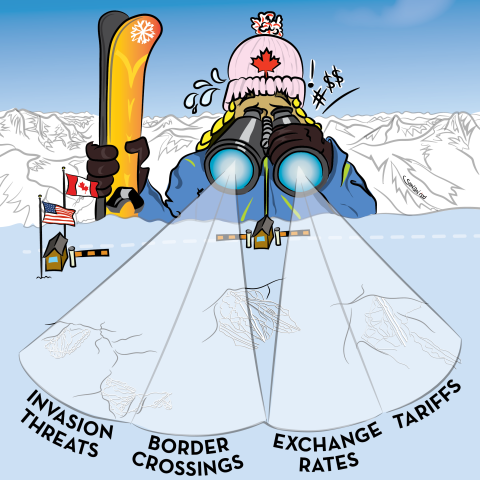
When we wrote about the U.S.-Canada tariff fight last year, tariffs were only part of the story (see the 2025 cartoon on the next page). Canadian travelers were canceling U.S. trips, cross-border relationships were strained, and ski areas and suppliers were bracing for higher costs on everything from equipment to capital projects.
A lot has happened since. In February, the U.S. Supreme Court struck down the Trump administration’s broad tariffs enacted under the International Emergency Economic Powers Act (IEEPA). But tariffs are now back at the center of U.S.-Canada relations.
New tariffs. On July 20, President Trump announced new 50 percent tariffs on nearly $20 billion worth of Canadian imports, including wine, cheese, andhockey sticks. Those tariffs, scheduled to take effect Aug. 19., were delayed for negotiations at press time.
This time, the administration is relying on Section 338 of the Tariff Act of 1930, which allows the president to impose duties of up to 50 percent when another country is deemed to discriminate against U.S. commerce. The White House says the new tariffs are a response to Canadian tariffs affecting U.S. autos, alcohol and dairy. Canadian officials counter that many of those measures were themselves imposed in response to earlier U.S. tariffs.
Other friction. And trade isn’t the only source of cross-border friction. This summer, Canadian wildfire smoke drifting into the U.S. became a bilateral dispute of its own. Sen. Bernie Moreno, R-Ohio, proposed sanctions against Canadian officials over the smoke, while Trump floated adding its alleged economic costs to Canadian tariffs. The latest tariffs reportedly aren’t punishment for drifting smoke, but the episode is another indication that the particular tide we wrote about last year hasn’t exactly turned.
Fallout. Neither has the tourism fallout. Canadian visitation to Western U.S. mountain destinations was down 30.2 percent this past winter, according to DestiMetrics. There are some signs of improvement: Canadian summer bookings were up 16.6 percent year-over-year as of July. But they remained well below 2024 levels, and cancellations had spiked.
Other tariffs never went away. The U.S. and Canada continue to levy duties on each other’s steel, aluminum, and autos.
The details of the trade fight have changed since last year, but the basic problem hasn’t. For ski areas and suppliers on both sides of the border, the costs and uncertainty remain.