



There are a lot of cool things that make a snowmaking system, not including the temperature. So we asked manufacturers and suppliers to tell us about their coolest products. The result is this collection of snowmaking infrastructure, equipment, and technology, all of which play a role in producing the final product our industry relies on.
Hey, snowmaking professionals: It’s time to geek out.
SMI Grizzly Low-E Stick
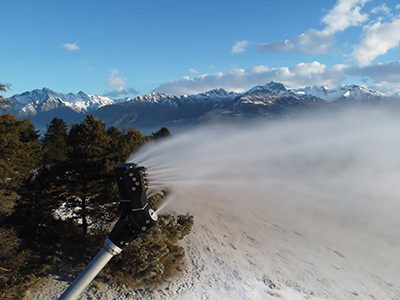 The Grizzly began with a ground-up redesign of SMI’s low-energy stick, with the head angled to direct the spray outward and a nucleator arrangement that looked to the design team like a grizzly paw. The name stuck.
The engineering choice underneath it is what matters in marginal temperatures. Snow forms when nucleated ice crystals meet the bulk water stream at the right moment—too early and the droplets do not have time to mix, too late and they pass through the freezing window before they combine. The current Grizzly uses dual-jet nucleation and 12 water nozzles, with geometry and spacing tuned to control that timing. The result is finer particle formation and reliable production.
According to SMI, the Grizzly requires 75 percent less compressed air than did the standard snowmaking sticks from more than 10 years ago. It is typically configured to perform at 10-60 cfm. The Grizzly is available in both manual and automated controls and can come in a double head configuration.
Bucceri All Weather Fan Gun
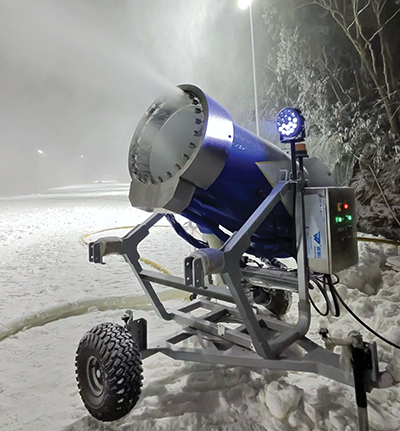 The Bucceri All Weather fan gun combines a fan gun with an integrated refrigeration-based nucleation system designed to produce snow across a wide range of temperatures. Rather than relying on a traditional compressor and nucleating valves, the system uses refrigeration modules to generate ice nuclei that seed snow formation.
The gun operates in three modes. In plus-temperature conditions, the refrigeration system produces snow directly without adding water. Around freezing, a “fog mode” combines ice nuclei with a fine water mist to improve heat transfer and snow production. In sub-freezing conditions, the unit uses water nozzles and refrigeration-generated ice nuclei to produce snow. The ice nuclei, says Bucceri, accelerate crystallization as the droplets mix with ambient sub-freezing air, increasing snow output while reducing refrigeration demand.
The refrigeration modules are scalable. A single onboard module generates an ice-nuclei volume comparable to that of a conventional fan gun, while multiple modules can increase capacity to as much as 10 times that of a conventional nucleator system, according to the company.
The All Weather system connects to existing snowmaking water and power infrastructure and can be configured with different control systems and ice-making capacities. Bucceri says plus-temperature production ranges from 15 to 250 cubic meters of snow per day, depending on the number of ice-making modules installed.
HKD Klik Automation
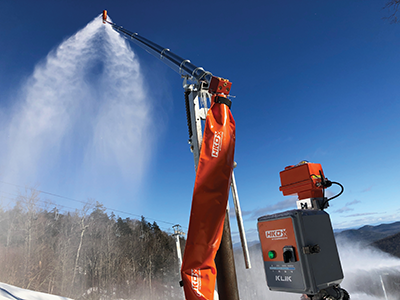 The Klik Hydrant System was conceived in 2010 to address snowmaker safety and improve the speed of system-wide startups and shutdowns. Available in both manual and automatic configurations, Klik is compatible with virtually any HKD snow gun manufactured in the last 15 years. Klik hydrant air and water hoses always remain connected because the hydrant system is installed slightly downhill from the fixed gun it feeds, so the water hose is gravity drained upon shutdown. This saves time during operations and limits hands-on interaction with high-pressure equipment, hoses, and couplers.
The Klik automatic hydrant is designed to automatically bring HKD towers online and adjust the output to the conditions. Paired with HKD’s air/water Impulse or Phazer tower guns equipped with variable airflow technology, the system can reduce compressed air consumption by as much as 80 percent as temperatures drop, according to HKD.
HKD touts the Klik’s water utilization rate when paired with an HKD tower gun. Compared to an “above-ground gun with traditional hydrant” on a 6,000-gpm system operating over a 12-hour snowmaking window, HKD says that cumulative pumping volumes increase from approximately 1.2 million gallons to as much as 3.6 million gallons during the same operating window.
Ratnik Cooling Systems
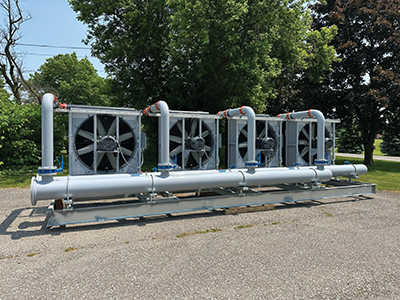 Ratnik’s cooling systems are designed to improve snowmaking efficiency by lowering water and compressed-air temperatures before they reach the snow gun. The product lineup includes water-cooling towers, compressed-air aftercoolers, and glycol-based compressor cooling.
Water cooling tower systems are available in sizes from a few hundred gpm to large, multi-unit installations of more than 6,000 gpm. Cooling tower systems are automatic VFD-controlled and are available with circulating pumps and level controls. Smaller systems can be skid or container mounted for easier site installation.
Compressed air aftercooling systems are designed to cool compressed air, enabling moisture to be removed for better snow gun reliability and efficiency. Ratnik provides automatic VFD-controlled air-cooled units, which are modular to accommodate different-sized installations. Systems can be packaged on prefabricated skids with coolers, motors, piping, valves and wiring all factory assembled prior to shipping.
Air-cooled systems eliminate the need to use water for cooling, important in areas where water is at a premium. Coupled with the Ratnik Flo-vane moisture separator, the systems can cool and remove moisture from compressed air before it enters the pipeline and affects snow gun performance.
Compressor intercooling, also called “glycol cooling systems,” cool air compressors without using water. Clean fluid circulates in a loop, eliminating fouling in compressor heat exchangers. Systems can be used with both centrifugal or rotary screw liquid-cooled compressors and feature automatic skid-mounted circulation pumps, outdoor air-cooled radiators, and automatic thermostatic controls.
Latitude90 All-Weather Snowmaking
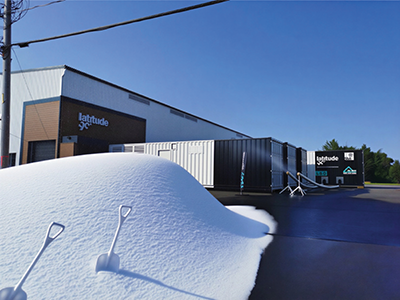 Latitude90 all-weather snowmaking systems use industrial refrigeration technology to produce snow independently of traditional wet-bulb conditions. Available in three different sizes—L30 (20-foot container), L60 (40-foot container), and L120 (two 40-foot containers, stacked)—the containerized systems can operate continuously and produce snow in ambient temperatures ranging from -4°F to 77°F.
The bigger the unit, the more snow it can produce, with the L120 making up to 264 cubic meters in 24 hours in an ambient temperature of 59°F. Flake size is adjustable, with larger flakes minimizing melt and smaller flakes producing a finer snow particle.
The industrial refrigeration technology was adapted into a machine that a resort could operate without a full-time refrigeration technician on staff, thanks to automation and remote monitoring; each motor and critical component can be diagnosed remotely by the manufacturer’s factory technicians, allowing for proactive support, says Latitude90. Operators start and run the machines through SmartSnow7 control software or a mobile device.
The systems are designed to work alongside existing snowmaking infrastructure to help resorts maintain snow production when snowmaking windows are limited or unavailable. For example, says the company, early-season all-weather system production can put down a snow base before ground temperatures support traditional snowmaking, letting conventional guns build on that base when the cold arrives.
TechnoAlpin TT10 Fan Gun
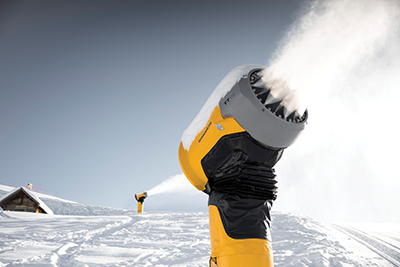 The TT10 is the newest fan gun from TechnoAlpin. It’s mounted on a unique tiltable tower with a mechanical lift cylinder that allows operators to lower the unit to perform maintenance at ground level rather than having to climb a ladder.
The central valve block has been replaced with new nozzle valve technology comprised of individually controllable single valves that adjust to the conditions. The TT10 also features a redesigned air cooler with a larger cooling surface for increased cooling capacity, improving snow production at marginal temperatures. It has wear-resistant double ruby inserts in the nucleators.
The TT10 can be configured to individual specifications to reduce costs for unused features. Optional extras available for the TT10 include a touch display, weather station, motorized electric swivel function with 320 degrees of rotation, and height adjustment facility.
The TT10 weighs 1,800 lb. and is delivered pre-assembled.
CHS Snowmakers Drift Snowmaking Additive
 Drift surfactant water additive was built specifically for the ski industry. It originally debuted in the late 1990s. CHS Snowmakers began as a Drift distributor before acquiring the rights to the product in October 2023.
As a surfactant, Drift works by breaking the surface tension of every droplet as water leaves a snow gun nozzle. By expanding the surface area of the water droplets, Drift accelerates heat release so the droplets freeze faster and more completely before they hit the ground, which can make for drier snow.
According to the company, microscopic testing revealed that Drift snow forms smaller bonds between the frozen pellets, creating more air space within the snowpack, which reduces clumping.
Torrent Prefabricated Pumps
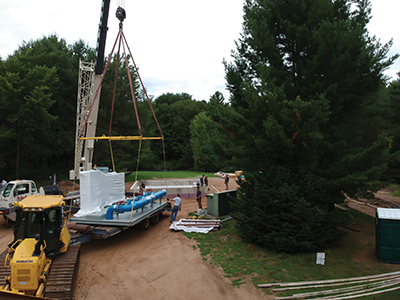 Torrent’s prefabricated pump stations are designed to simplify snowmaking infrastructure projects through standardized, pre-engineered configurations. Available in five configurations, the lineup ranges from low-pressure transfer systems capable of more than 20,000 gpm at 400 psi to high-pressure uphill delivery stations exceeding 20,000 gpm at 1,400 psi. It also includes in-line booster stations available in single-, duplex-, triplex-, and quadplex-pump arrangements, as well as submersible and floating units for specialized site conditions.
Every station comes standard with solid-shaft vertical motors with altitude, VFD, and space-heater options; epoxy coating; non-corrosive bolting; individual pump isolation valves; system drain valves; integral flow-meter pipe spools; and Snomax injection control in the controls layer. Factory assembly covers pump alignment, electrical termination, panel build, and hydrotesting.
Options include stainless construction, strainers, filtration modules, service entrance rated electrical distribution, and harmonic mitigation. Custom layouts and weatherproof enclosures are available.
Standard GA drawings for one- to five-pump configurations let planners assess footprint, manifold, and electrical room sizing before engineering begins.
Bollfilter aquaBoll
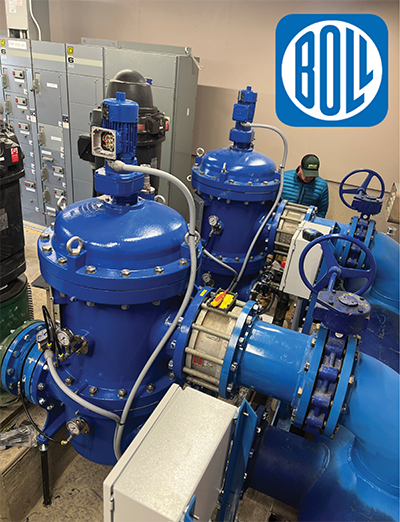 The Bollfilter aquaBoll is an automatic filtration system designed to remove contaminants from snowmaking water systems. Available in nominal sizes from DN2” to DN40” and pressure ratings from 145 psi up to 580 psi, the automatic filtration system can be adapted to a wide range of flow rates and installation requirements. Housings are offered in cast iron, welded steel, or stainless steel, depending on the application and water quality.
Bollfilter (Boll & Kirch GmbH) offers a range of filter elements tailored to varying dirt loads and particle characteristics. Filter elements can be adapted to changing raw water conditions and application requirements, helping protect pumps, snow gun and lance nozzles, and downstream equipment such as UV treatment systems.
The aquaBoll uses an application-specific flushing orifice to optimize flushing volume and cleaning performance. Different flushing orifices are available for varying water qualities and contamination loads. The configuration is intended to maintain backflushing performance as water conditions change during snowmaking operations.