



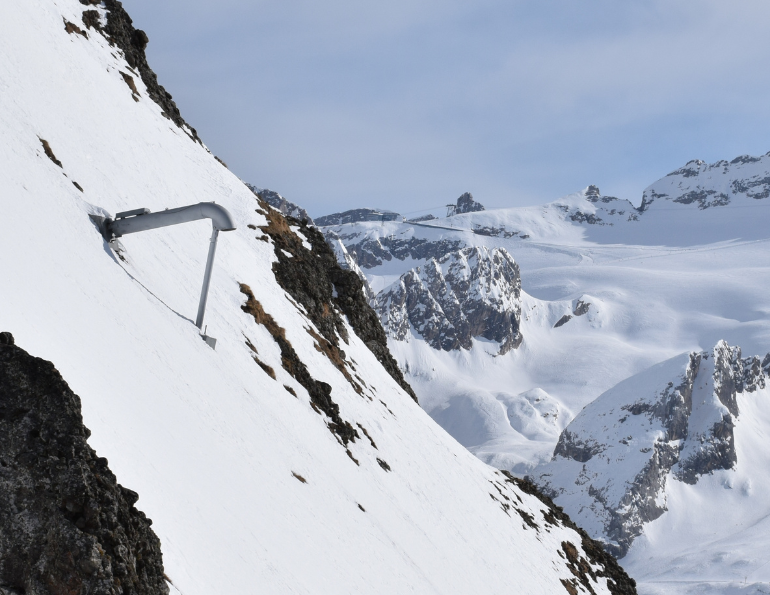
Patrollers at Jackson Hole Mountain Resort, Wyo., heard a deafening roar above as an in-bounds avalanche came barreling toward them. It was 9:26 a.m. on Dec. 30, 2008, and the patrol team was doing routine avalanche mitigation work on a steep southeast aspect above the Bridger Restaurant known as The Headwall. Though no serious injuries occurred, seven patrollers and the restaurant were at least partially buried.
This wasn’t the first, nor would it be the last, in-bounds avalanche incident involving ski patrol operations at a North American resort.
In the last few years, the dangers of avalanche mitigation work and an increased focus on worker safety have led to an uptick in remote avalanche control system (RACS) installations in North America. Just one year after the Jackson Hole Headwall avalanche, the resort installed its first three Gazex RACS, replacing artillery and complementing the hand charges that had been the primary mitigation tools.
“We started building lifts, restaurants, and buildings in some of those zones, and artillery and infrastructure aren’t very compatible because of the shrapnel,” says JHMR ski patrol director Drew Kneeland. “Our targets started shrinking, and Gazex was a great option for us to remotely mitigate that terrain. It gave us the ability to address the area more frequently and with a larger force, minimizing the size of the slides.”
The Technology
Gas-based systems. Today, there are two main categories of RACS: gas- and explosive-based, both of which are triggered via radio or satellite communication. Gas-based systems are typically fueled by propane or hydrogen and oxygen, the latter of which is pumped separately into a detonation chamber, then mixed and detonated via electrical charge. Traditionally, systems like Gazex have used propane, which is extremely energy dense. But propane liquifies at low pressures, hindering its ability to be pumped uphill. Hydrogen, while less energy dense than propane, can be pumped uphill, providing more flexibility around gas storage locations.
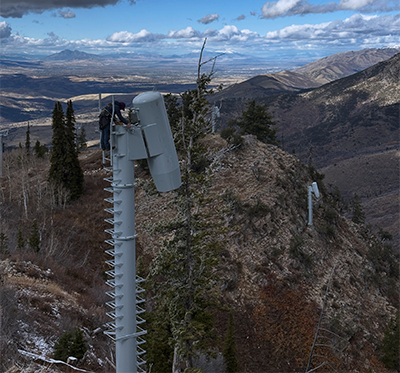 Powder Mountain, Utah, installed five Boom Whoosh units to serve a terrain expansion.Alpine Infrastructure, a Wyoming-based company that designed its first RACS in 2023, the Boom Whoosh, has created an adjustable system that utilizes oxygen and hydrogen, along with a small 12-volt battery.
“One of the advantages of propane is how energy-dense the storage is. You can get an insane amount of propane in a single 100-gallon propane cylinder,” says Eric Bressler, founder of Alpine Infrastructure and creative mind behind the Boom Whoosh. “Think about how long you can boil water and how much water vapor is created before it’s empty—it’s the same thing.”
As a result, propane-fueled systems require a smaller gas storage area. But for Bressler, hydrogen has its own advantages, with the flexibility of gas storage location being one of them. “We can push [hydrogen] up to 3,300 feet and 1,500 feet vertically uphill.”
At some resorts, where propane can be stored in an accessible location, refilling the storage area with canisters isn’t an issue. But many locations require long hikes in or even helicopter drops, which can cost $2,500 per hour and are weather-dependent, to refill the gas. Another benefit of hydrogen is that, unlike propane, it can be stored near occupied structures such as chairlifts.
Explosive-based systems. Explosive-based remote avalanche control systems, like Wyssen avalanche towers, use explosives that are pre-placed by helicopter and deployed throughout the season. Unlike gas-based systems, explosive-based RACS sometimes have to be reloaded via helicopter mid-season, which can be limiting due to cost and weather. Explosive-based systems do have a radial shot (whereas gas-based systems have a directional shot) and a higher detonation speed, which can be more effective in triggering avalanches. But in many situations, limitations might drive operators toward gas-based systems.
“If you’re in a situation where you’ve got to reload more than twice a winter, gas-based systems are probably starting to look pretty attractive,” says Greg Johnson, founder of Six Points Engineering, an avalanche risk and mitigation consulting firm.
New takes on RACS. MND, the company that created Gazex, also offers another gas-based remote solution called O’BellX. Unlike the Boom Whoosh and Gazex, which are both fixed, the O’BellX can be removed by helicopter and brought to a central location for maintenance and refilling, a useful option for locations in complex terrain.
“You can actually store the unit in a garage or parking lot, so it isn’t as unsightly on the mountain. And most of the work takes place down in the valley. But you need a helicopter to reload and re-arm it,” says MND North America project safety manager Brandon Dodge. “You still need concrete [on the hill], but it requires much less infrastructure. You don’t need a building or gas lines on the mountain.”
Their newest model, the O’BellX 1.8, is a hybrid system with a fixed tower and detonation unit but a removable controller unit. The O’BellX 1.2, MND’s smaller, removable RACS, is capable of 24 shots before requiring a refill, while the 1.8 is more powerful and capable of 60 shots.
Drone Amplified, founded in 2017 to develop aerial ignition systems for wildland fires, has been working with the Alaska Department of Transportation, which was seeking an alternative to the howitzer, to develop RACS that don’t require fixed infrastructure or helicopter drops. Drone Amplified is instead utilizing a drone-based system, called “MONTIS,” that drops explosive charges in avalanche-prone areas and could be better for operators who might not be able to justify installing a RACS but still need a few shots a year. This system can be adapted to whatever charges a ski area is already using, according to the company.
[For a deeper dive into the performance characteristics, blast profiles, and operational tradeoffs of different remote avalanche control systems, see “Blast Off: RACS Testing” in the September 2022 issue of SAM.]
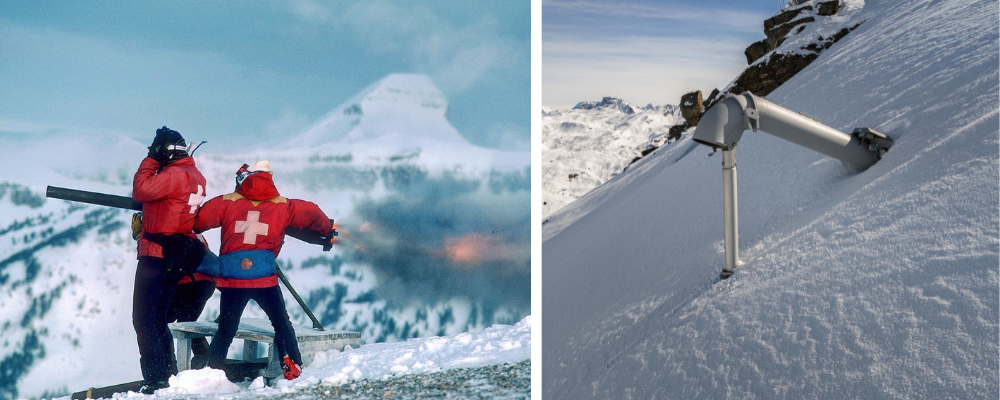 Left to right: Patrollers Peter Mackay and Todd Harley fire the now retired 75 mm recoilless rifle for avalanche mitigation at Jackson Hole (Credit: Wade McKoy). RACS like the MND Gazex, have long been utilized in hard-to-reach terrain in Europe.
RACS Heat Up in North America
Ammunition depletion. The recent uptick in North American interest is influenced by several factors, the limited supply of artillery ammunition chief among them. The army is phasing out the stationary howitzer, and the ammunition for it is disappearing as well.
“The army hasn’t set a deadline, but they’ve made it clear that the howitzer will be going away,” says Bressler. “So, any howitzer user needs to find an alternative.”
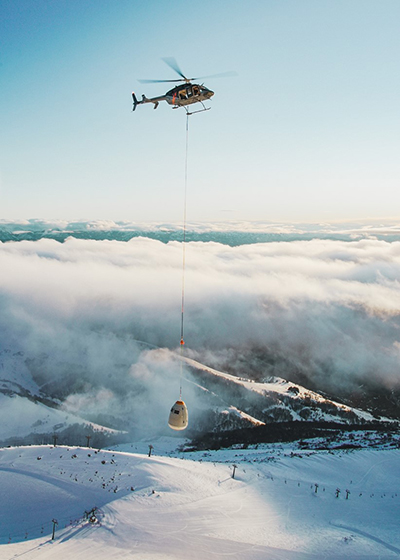 O’BellX, a gas-based RACS from MND, is refueled and re-armed via helicopter transport. Credit: Cerro Catedral, ArgentinaOnce howitzers are phased out, operators will still have the option to use other traditional avalanche mitigation methods, such as hand charges and explosives deployed from helicopters. But RACS, like the howitzers, can be used to mitigate larger avalanches before sending patrol in with hand charges to deal with smaller pockets. They can also be a viable alternative to costly helicopter flights.
Until recently, this wasn’t a concern. North American patrollers have not only been OK with using artillery—which is cost-effective and reliable—for avalanche mitigation work, but they’ve typically enjoyed it. As a result, RACS have caught on more slowly in North America than in Europe, where they originated.
“I remember missing the phosphorus tracer rounds we used to fire from the recoilless rifle,” says Jackson Hole’s Kneeland of his time patrolling. “You could follow the arc of the round as it flew towards the Headwall. But the end of the artillery program at Jackson Hole was inevitable, and I’m grateful it was replaced by a reliable system that’s efficient and effective.”
Safety upgrade. Kneeland adds that RACS have been a great tool for supporting patroller safety, which is another obvious driver of the systems’ uptick in popularity. Over the years, there’s been a shift in focus from costs and ROI to worker safety.
“Ski patrol is a hidden cost. They don’t sell lessons or burgers—it costs money,” says MND’s Dodge. “But they’re critical for operating a ski area. Now, when you put ski patrollers in harm’s way, and if they get hurt, you have to answer to OSHA. And you have to look at that as an operator, whether morally, legally, or financially.”
Efficiency. The ability and pressure—applied by photos and videos of long lift lines popping up on social media—to open terrain efficiently are other drivers. RACS allow large areas to be mitigated remotely before lifts start spinning, so patrol can take care of smaller pockets, getting terrain open quickly and efficiently.
While the implementation of RACS doesn’t necessarily reduce the number of man-hours required for ski patrol teams, it does shift the workload. Patrollers typically become responsible for maintaining the RACS, swapping gas canisters when they run out, and using freed-up time to deploy charges in areas they otherwise wouldn’t be able to reach until later in the day.
Utah’s Powder Mountain, which is in the process of opening new zones on the private and public sides of the resort, saw the value in adding RACS, particularly because of their ability to help open expansive terrain more quickly. Ahead of the 2025-26 ski season, the team decided to install five Boom Whoosh units to mitigate avalanches around the new Primetime lift in the 1,200-acre Davenport zone, which previously wasn’t a lift-accessed part of the resort.
“This expansion into the Davenport terrain is putting us in some really big avalanche slide paths, and we wanted to make sure we could manage the avalanche risk the best we could,” says Powder general manager Kevin Mitchell. “It does save on man-hours, but it’s mostly about safety. We can take care of the bigger avalanches before patrol gets there to take care of the smaller ones.”
The team plans to add explosive-based Wyssen towers in another new zone, Don’t Mention It, or “DMI,” which Mitchell notes has narrower chutes and cliffs. Since the terrain is bigger, more complex, and harder to access than the Davenport zone, the helicopter-loaded option was preferable.
The Costs
Of course, implementing these systems comes at a cost. While the cost per shot is relatively low, installing the infrastructure and paying for helicopter flights both come with heftier price tags.
At Powder, opening the Davenport zone required bringing power to the new lift, from which lines were run to each Boom Whoosh tower. The team also had to run gas lines from the central gas storage location to each tower, and install communications.
It can be complicated. The actual cost of installing and implementing these systems varies widely, depending on geographic location, terrain, and system type. But Bressler says he’s hoping to come in at under $250,000 per unit for his Boom Whoosh towers, though he’s still making pricing adjustments and learning about costs as more of his towers are installed.
“We’ll see where we land at the end of this year, but I know three years ago, before I rolled out my system, program managers were budgeting approximately $250,000 per unit,” says Bressler. “With the price of steel in the last 18 months, that’s probably higher now.”
Boom Whoosh is made in the States, so steel import tariffs aren’t a factor—although U.S.-produced steel prices have risen precipitously since new tariffs were implemented in 2025. European manufacturers, which are affected by tariffs, are likely to increase prices in the near term. Six Points Engineering’s Johnson sees a future in which growing competition will eventually drive prices down, though.
Operation and maintenance. Conversely, operation and maintenance costs are relatively minimal, but highly dependent on site accessibility. At Jackson Hole, Kneeland has experienced failures requiring pipe or tube replacement, but, he says, most maintenance is limited to ensuring nuts and bolts are tight and keeping up with software updates. The team at Jackson Hole has utilized a mix of in-house staff and manufacturer maintenance plans for upkeep.
Regulations and permitting. Regulations around installation and operation of RACS aren’t a huge issue outside of California, according to Johnson. Regulations vary by state and land management/ownership, but typically require permits from counties, municipalities, and the U.S. Forest Service, among others.
“There’s quite a bit of momentum in the U.S. right now for RACS,” says Johnson, “and because they’re viewed as a safety device, you have to jump through those permitting processes. But there isn’t a ton of resistance.”
California is the exception. For nearly two decades, the state’s ski industry has been advocating for and pursuing regulatory approval to use explosives-based RACS, but it is slightly behind other states. Over the last few years, the California OSHA standards board has been exploring a new standard for explosive-based RACS. This lengthy and complex process involves members of the ski and explosives industries, avalanche associations, and government agencies, and, while it is ongoing, a draft is nearing release for public comment. RACS technology has improved throughout the process, resulting in numerous revisions that have added to the time and complexity.
Some systems are already operating in the state; both Mammoth and Palisades Tahoe have also applied for temporary experimental variances to install systems ahead of the 2026-27 ski season, but approval is pending. Regardless of the hurdles, there is a clear demand.
An inevitable transition? In the coming years, installation and implementation of RACS in North America will likely grow as ski areas recognize the value in staff safety and operating efficiency. Europe might be ahead of the curve, but it’s only a matter of time before North America catches up.