

Planning a trip with AI is now mainstream, especially among younger travelers. In Klook’s 2026 Travel Pulse, a survey of 11,000 millennial and Gen Z consumers, 91 percent said they use AI as a travel planning tool for things like research, itineraries, and budgeting.
That changes the stakes of a simple question: When a traveler asks an AI chatbot where to go in the summer, do mountain resorts show up at all? That’s what SAM and Centium set out to answer.
In contrast to a search engine that surfaces 10 blue links (or more for the rare person who makes it to page two), an AI chatbot returns a single answer, assembled from a collection of webpages and its own knowledge base. Traditional search is a mature channel with plenty of analytics resorts have come to rely on. AI search is an emerging one with minimal data, so we set out to build our own dataset and measure the gap between the results of queries about winter and summer.
Methodology
Centium, an answer engine optimization platform, ran 345 brand-neutral trip-planning prompts across AI platforms ChatGPT, Claude, Gemini, Perplexity, and Grok in May 2026, generating 1,725 responses.
No prompt named a ski area. Instead, we asked the types of trip-planning questions a traveler might ask (think: “Best places to go for a family vacation in the Pacific Northwest?”) and measured whether a resort appeared in the response. A response counted as a resort mention whenever a ski area was named. A town, valley, or lake that is home to a resort or resorts (e.g., Aspen, Jackson Hole, Lake Tahoe) was treated as a destination, not a ski area, and reported separately.
Sourcing—that is, where AI gets its information from—was measured at the website level (the domains AI references) and the page level (the individual articles).
Prompts covered eight regional summer categories, seven cross-regional summer categories, and eight winter benchmark categories. Regional summer prompts asked about where to find hiking, biking, family activities, festivals and other summer experiences across six U.S. regions—Northeast, Southeast, Midwest, Rocky Mountain, Pacific Southwest, and Pacific Northwest—Canada East, and Canada West.
Cross-regional prompts focused on trip types such as mountain vacations, cool-weather escapes, family vacations, biking, wellness, culinary travel, and adventure activities like zip lines, mountain coasters, and aerial parks, across both day trips and overnight stays. These prompts were not tied to a location so that a ski area anywhere in North America could surface in a response.
Winter benchmark prompts mirrored those regional and cross-regional groupings with ski-specific and broader winter-travel questions such as top winter activities, where to snowshoe, and best winter getaways.
The Competitive Field
The headline is stark. For winter queries, a ski area surfaced in 87 percent of regional answers, averaged across the eight regions. For summertime queries, that fell to 51 percent. This disparity reflects, and quantifies, what most ski areas see on site and almost certainly in their typical web traffic. The underlying phenomenon is the same, less seasonal interest and a lot more competition for those keywords, but the medium is new.
The gap in AI hits is not a quality problem; it is not that resorts are doing a poor job at summer operations. It’s that the field of competition, as we know, greatly expands in summer, and an AI answer has room for only so many recommendations. The model names about as many destinations, attractions, or places to visit in summer as in winter: 10 on average, across all five AI models. In summer, though, parks, towns, trails, and attractions all compete for those spots, so a resort’s share shrinks compared to winter.
Asking what to do in the mountains in the winter is nearly synonymous with asking where to ski or ride. The competitive set is other resorts, and AI responses reflect that. Across the winter answers to every query we asked, 40 percent of every place the models named was a ski resort.
When asking about what to do in the mountains in summer, national parks, free public trails, gateway towns, state forests, and roadside attractions all enter the chat. As a result, the ski industry’s share of specific mentions collapses from 40 percent in the winter to 13 percent in summer. Public lands and “nature” double their share, from 19 percent for winter queries to 39 percent for summer, and become the loudest voice in the room.
Consistent results. The pattern held across all five platforms, which points to their similar training datasets. Gemini was the most generous to resorts, naming one in 68 percent of summer answers. ChatGPT was the toughest room at 37 percent, with the widest seasonal gap of any model. A resort missing from one tool is usually missing from the next. This is not a gap that can be closed one platform at a time.
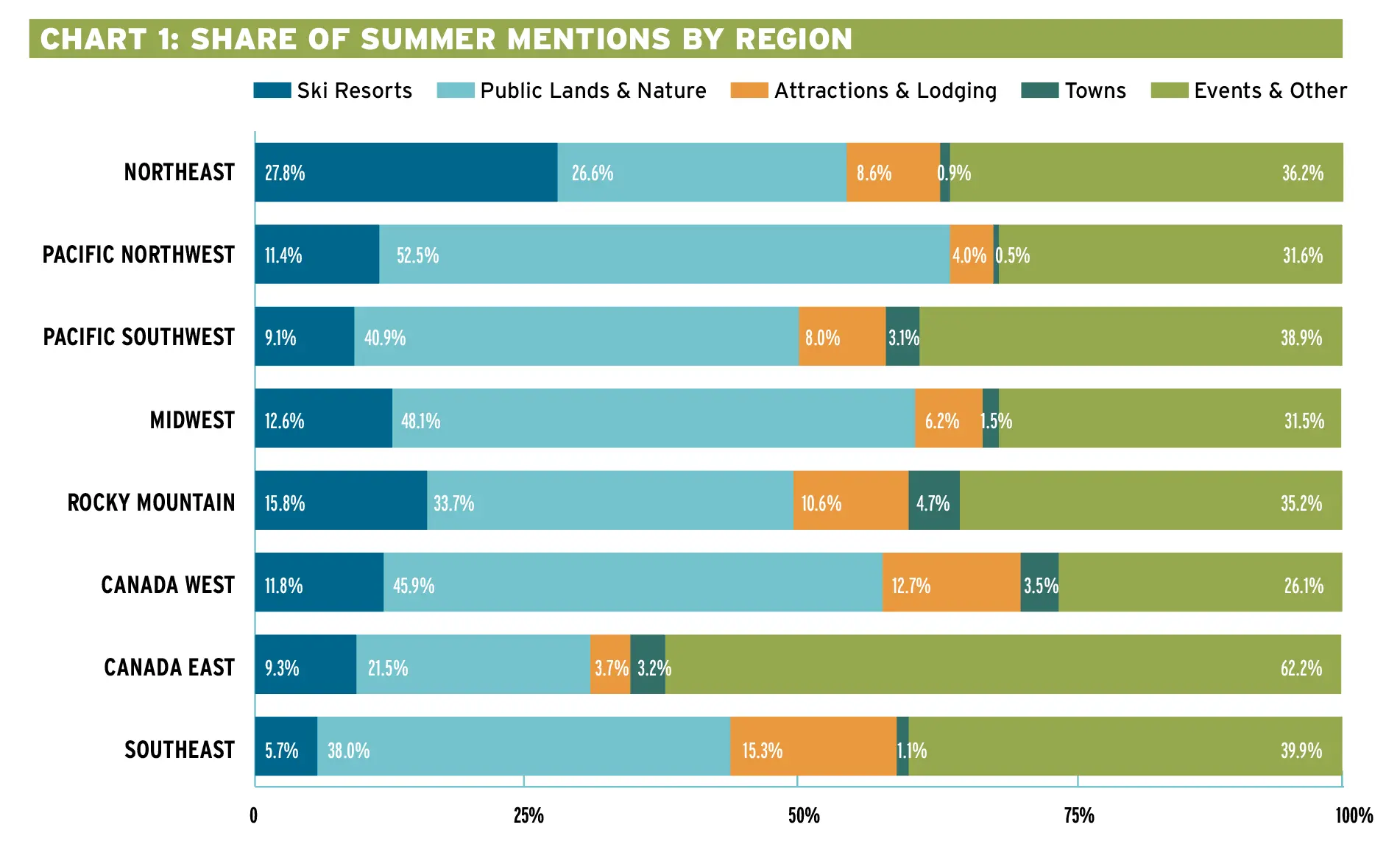
Regional variance. Depending on the region, that room may be more or less crowded with competitors. As seen in Chart 1 (below), which shows the percentage share of mentions across five categories—ski resorts, public lands and nature, attractions and lodging, towns, and events and other—in response to summer regional prompts, ski resort mentions have a larger share in the Northeast and nearly disappear in the Southeast, while public lands carry the West, in large part due to prevalence of national parks.
The most-named places in the entire study make the point on their own, with national parks claiming seven of the top 10 most-mentioned destinations. Whistler Blackcomb, B.C., fourth on the list, was the only resort to break into that company. A resort competing in winter is competing against other resorts. In summer, it is competing against an entire region’s worth of things to do, most of which are free, famous, and evidently, already top of mind for the model.
Mind the Gap
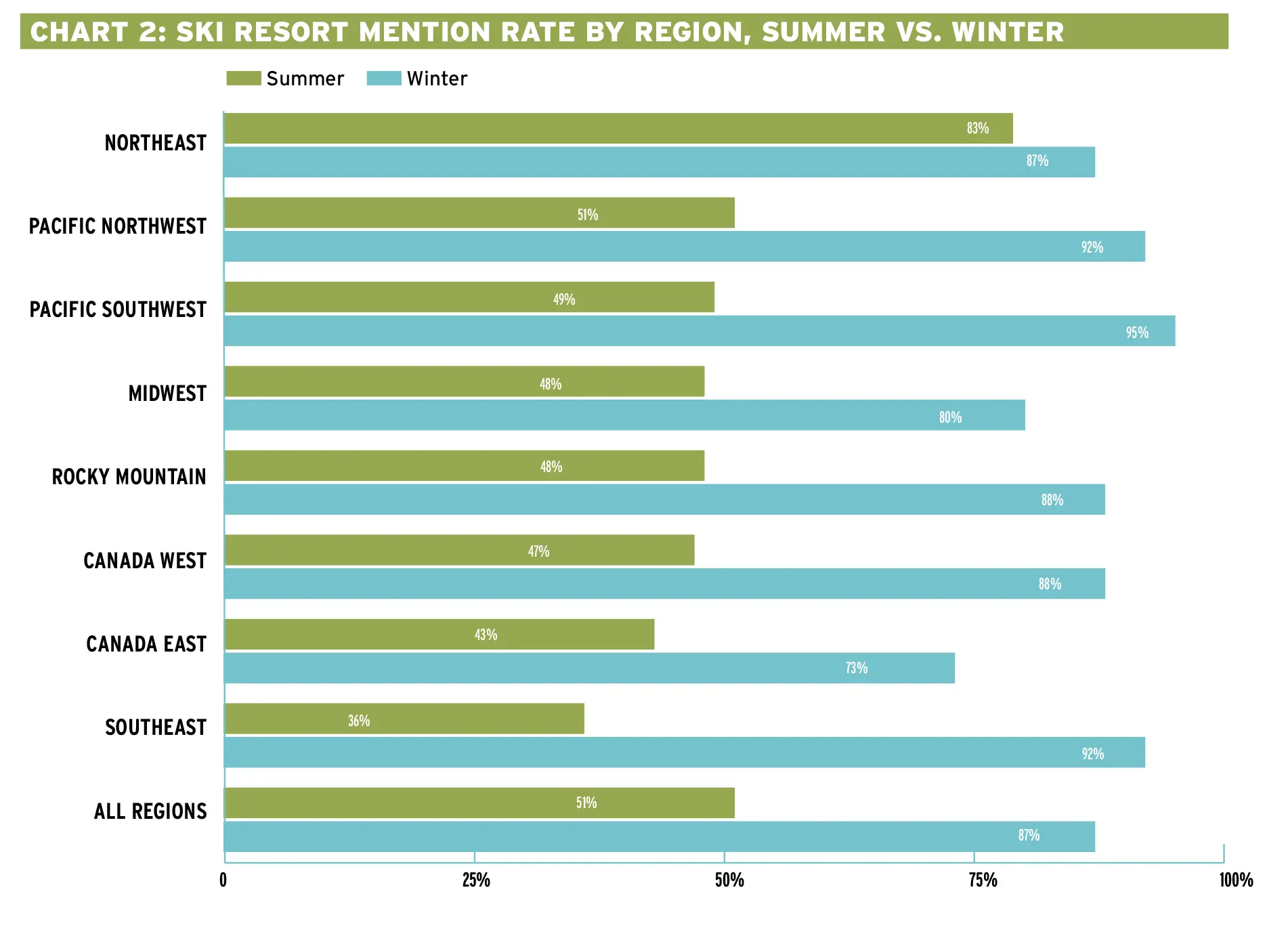
The gap between the number of mentions in summer-related AI queries vs. winter-related is not uniform (see Chart 2, below), and the variation is the part operators can act on.
The Northeast is the bright spot. There, resorts surface in 83 percent of summer answers against 87 percent in winter, a gap of almost nothing. The likely reason: Northeast resorts face the thinnest field of rivals we measured. Northeast summer answers name just one national park, Acadia, against the six to 12 parks typically named in responses about the western U.S. and western Canada. Even the non-resort places that surface in the Northeast tend to be resort-adjacent—such as Vermont’s Mount Mansfield, home to Stowe Mountain Resort—rather than independent draws on the scale of, say, Great Smoky Mountains National Park in Tennessee.
Resort density and ownable summer programming surely help, but the clearest signal we measured was the field itself: where fewer headline public lands and towns compete for the answer, the resort holds its place into summer.
The western regions and Canada West cluster in the middle, with summer resort mention rates at nearly 50 percent and winter rates near 90 percent. But a large share of their summer miss is attributable to a specific phenomenon: the destination eclipses the resort. In the Pacific Southwest, for example, the model answers with Lake Tahoe and Mammoth Lakes rather than any adjacent ski areas. In Canada West, it answers with Whistler and Lake Louise rather than their resort counterparts.
Overall, we measured that 8 percent of answers to regional summer prompts named the town or valley in which a resort is located without naming the resort itself. Counting that as partial credit lifts summer visibility from 51 percent to 59 percent. In winter, that figure is only 3 percent because in winter the model sees the resort as the primary attraction.
Strengthening regional ties. Whether the destination’s mention, sans resort, in AI search results counts as a win depends on how closely tied the resort is with the destination, among other factors. The point is that the resort brand and its destination are not the same entity to an AI model, and in summer, the destination is winning.

This is something operators can act on, though, improving their own AI standing through association. If a ski area can get itself named alongside the destination in the sources AI uses—area “things-to-do” coverage, regional roundups, tourism-board content, etc.—the model will connect the resort to the destination name it already trusts, and share that with searchers, instead of treating it as a separate entity.
Cross-Regional Themes
When it comes to the seven cross-regional themes, which included prompts based on trip type rather than by region—think: the kind of broad prompts people use when they are still dreaming rather than booking, like, “Where should I plan a summer mountain vacation?” or “Best places to escape the heat?”—the answers split cleanly into things resorts own and things they do not.
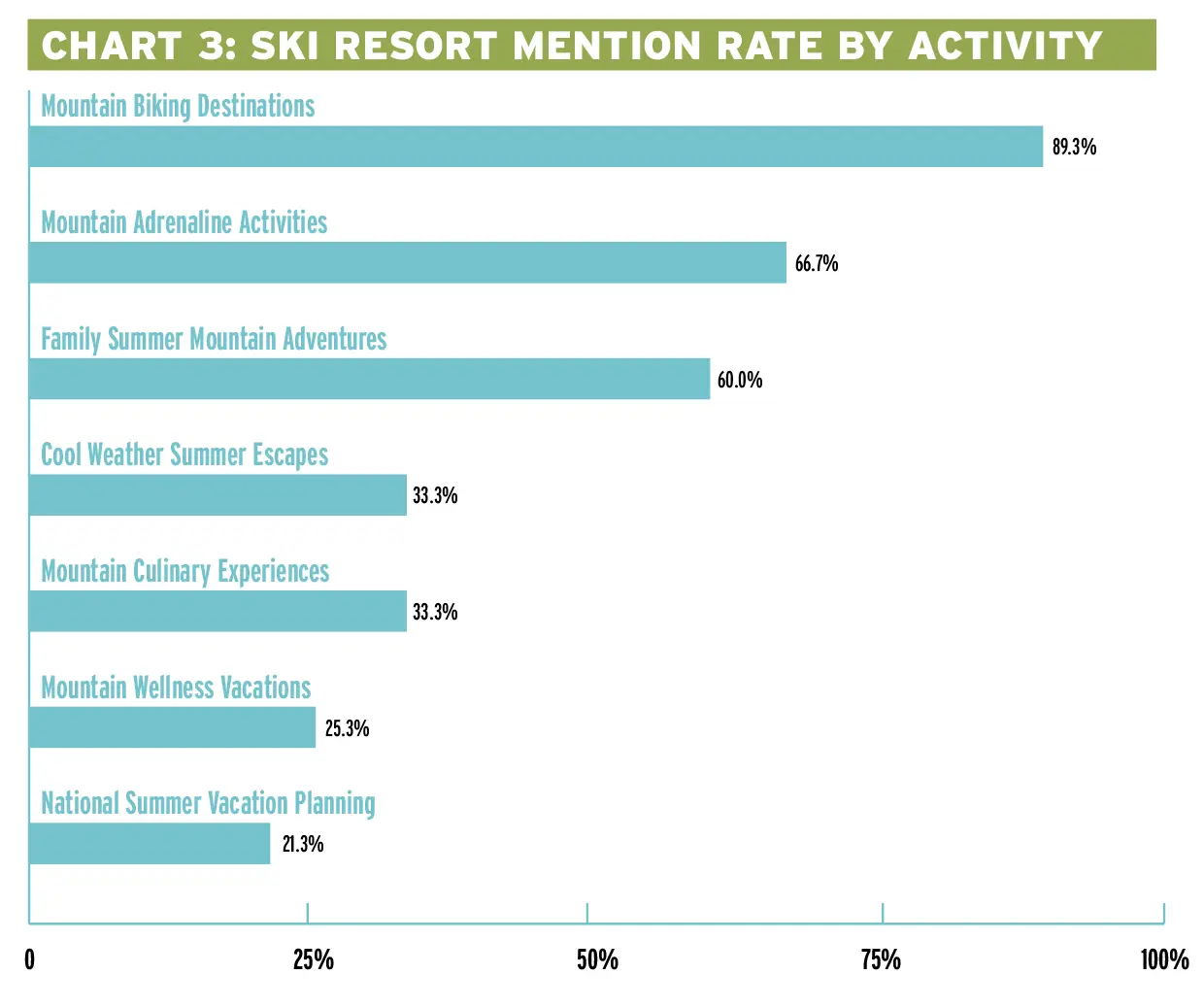
Infrastructure-specific questions. Ski areas win decisively where they’ve built the infrastructure (see Chart 3, below). Questions about mountain biking, for example, surfaced a resort 89 percent of the time. Lift-served bike parks are unambiguous resort assets, and the models know it. Mountain adrenaline questions, where we asked specifically about coasters, zip lines, and aerial parks, surface a resort 67 percent of the time. Questions around family mountain adventures surface a resort 60 percent of the time.
High-funnel questions. The picture inverts on the high-funnel questions. National summer vacation planning, one of the seven cross-regional themes that focused on a cluster of broad “where should I go this summer?” -type prompts, names a resort just 21 percent of the time, the weakest of any theme. Wellness lands at 25 percent, culinary and cool-weather escapes at 33 percent.
Resorts appear once a traveler already knows they want to ride a bike or a coaster. They are barely visible while that traveler is still deciding where to go at all.
Where AI Gets Its Information
AI assembles every answer from online sources, and across the study the models referenced more than 3,100 different websites. The single most referenced was the National Park Service. Nps.gov appeared in 199 answers, more than any resort, tourism board, or magazine. Behind it came TripAdvisor, Wikipedia, the ski-conditions site OnTheSnow, and activity platforms travelers use to plan such as Komoot and AllTrails. No single site dominated in this broad research and sources varied by region. Visibility was distributed across an ecosystem of regional blogs, destination-marketing sites, and one-off articles.
Resort websites. The mix shifts with the question. For winter-related questions, resort-owned websites are a major source, around 27 percent of the sites AI references. That share falls to 20 percent for regional summer-related questions, and to 15 percent in the broad national and planning questions, where public-lands sites, tourism boards, and activity platforms take over. The narrower and more local the question, the more AI leans on the resort’s own site. The wider the question, the less it does.
At the page level, the documents AI leans on most are roundups and rankings. The most-referenced single page in the study was a Marriott travel guide to the best summer mountain resorts. Close behind were an Ikon Pass resort ranking, a ski magazine’s Northeast summer guide, and a run of family-travel roundups.
Ranked lists. These third-party articles that aggregate destinations into a ranked list are the format the models reach for most often. Earning a place on them is a media-relations discipline, not a web-maintenance one. It’s becoming more important than ever to build relationships with the writers and outlets that publish these roundups, and earn rankings and accolades, rather than just tuning your own site. As AI models lean on third party validation, it is one of the strongest ways to move the needle for your ski area’s visibility in AI-led searches by potential travelers.
What It Means for Resorts
Summer is a discovery problem, and the medium where discovery happens has moved. Four things follow:
Lean into what already works. Resorts win the activity-specific questions because they own the activity. The bike park, the coaster, the aerial adventure should be distributed everywhere a model might look, so the strongest signal gets stronger.
Fight upstream. The expensive gap is the high-funnel prompt, such as the “best summer trip in the Rockies?” That is where resorts lose to parks and towns, and it is where the guest is actually deciding. Earning a place in the regional things-to-do content that AI uncovers matters more than creating another page on the resort’s own site with clever keywords.
Get others to talk about you. Simply putting activities on your website is not going to cut it in an AI-powered era. When the models aren’t naturally seeking your offerings out, it becomes critical to be mentioned where they look. Invest in public relations, build relationships, collect accolades, manage your reputation on review platforms like TripAdvisor, and create a digital footprint so large that AI models can’t ignore it.
Travel with the destination, not against it. In summer, the national park and the gateway town are not only rivals for attention. They are the entities the model already trusts, and in places like Gatlinburg, Tahoe, Jackson, and Whistler they are often named while the resorts are not. However, the content that surfaces them is content a resort can be part of. A resort named alongside Banff or the Tahoe shoreline uses the destination’s gravity instead of fighting it.
Existing data show the summer resort guest tends to leave satisfied but return slowly. That cycle starts long before the visit, in a chat window, with a question that does not yet have a resort in the answer. This study measures how often that happens, region by region and question by question. The next move belongs to the operators