



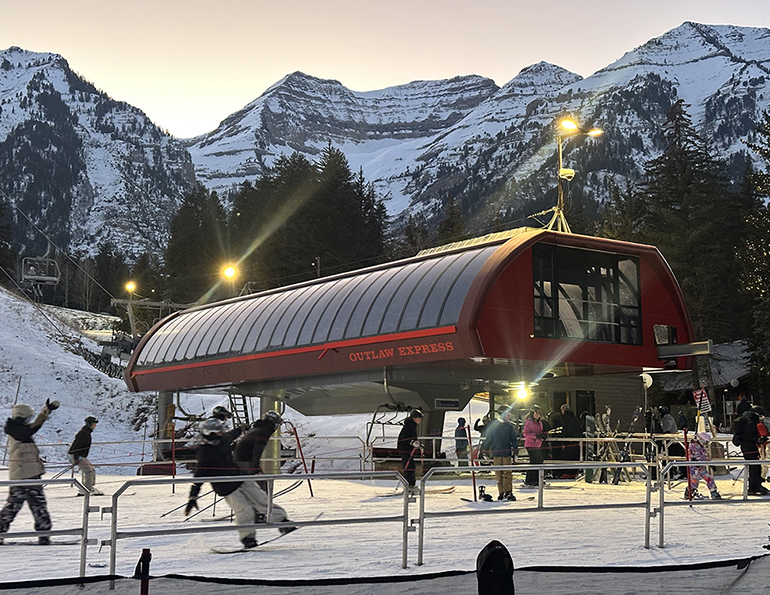
This rustic, soulful resort is an anomaly, but the well-capitalized, strategic rebirth of Robert Redford’s legacy is chock full of lessons for all resort operators.
By Andy Bigford
(This is the second stop on Andy Bigford's Revival Road Trip, where he is offering monthly reports from the road as he works on the third installment in the Ski Inc. book series. More from Andy Bigford here.)
For the 2026-27 winter, when low pressure, snow and cold theoretically return to the West, Utah’s Sundance Mountain Resort will unveil a predominantly advanced 165-acre expansion, its largest in 40 years. The backside Electric Horseman Express four-pack, a Doppelmayr named in honor of the 1979 movie, will climb almost 1,900 vertical feet before unloading at the Bearclaw Summit (another nod to another famous film). Traversing the Far East Ridge and Bishop’s Bowl, with mountain views essentially unmatched in the U.S., the lift will access 100 acres of previously off-limits (and largely hidden) bowl terrain. Directly underneath the lift lies a unique, 1.5-mile-long “dark blue” cruiser called Storyteller; it was literally carved from the mountain ridge after crews moved 200,000 cubic yards of dirt.
This should be huge for skiers, riders and the bottom line, but it’s also a lasting salute to the ownership old and new. President and GM Chad Linebaugh straddles both eras; he started at Sundance as a waiter more than 30 years ago, grew close to owner Robert Redford as he ascended to the top spot, and has worked hard to earn the trust of the resort's new stewards.
Continuity and change. Linebaugh calls this expansion the second of the resort’s two critical “milestones” in its rebirth. It comes after the opening this season of the 63-room Inn at Sundance, the resort’s first lodging property beyond its 100 secluded, upscale cottages. The inn straddles the North Branch Provo River and offers a rustic luxury that merges the old and new, paying homage to the communal gathering spaces of long-ago ski lodges (particularly in the Living Room), while offering the latest technology and elegance. Just opening to the public, it has already earned compelling reviews from the “big three” in luxury travel: the New York Times, Condé Nast, and Architectural Digest.
Welcome to Sundance’s post-Redford period in the year after the famous actor’s passing, where new owner Storyteller Canyon Investments navigates a narrow and at times precarious trail: Forging a sustainable, profitable future while honoring Redford’s past, where 70 percent of his playground is set aside for preservation.
Ideal for Reinvention
Sundance is the perfect pallet for the revival and reinvention of a ski area, a visually stunning and woodsy enclave perched in the shadow of 11,753-foot Mt. Timpanogos. It’s a short drive from greater Provo (population 500,000 for Utah County), a market that includes the collegiate energy of Brigham Young University and Utah Valley University.
This throwback valley, seemingly frozen in time outside of today’s frantic ski resort vibe, had been Redford’s home and legacy for a half century. In 1969, he showed up on his motorcycle in the narrow Provo Canyon and began to transform it into a haven for nature and the arts. Starting with his own A-frame home, his mantra was to “develop a little and preserve a lot.”
It’s always been a place where Hollywood visitors from Quentin Tarantino to Matt Damon and Natalie Portman can settle comfortably into a meal at the Michelin-keyed Tree Room or pull up a seat at the original, circa-1890s Owl Bar, while steps away brown-bagging skiers yo-yo the slopes, including under the lights, when the college crowd comes out in force.
Among Redford’s many worldly attributes—beloved actor, director, and producer; artist; renowned defender and protector of the environment—being a ski resort owner-operator was not at the top of the list, maybe not in his top 100. As the costs and challenges escalated in the 21st century, and as the big paydays from Academy Award- and Oscar-winning movies naturally began to diminish with age, so did the ski area.
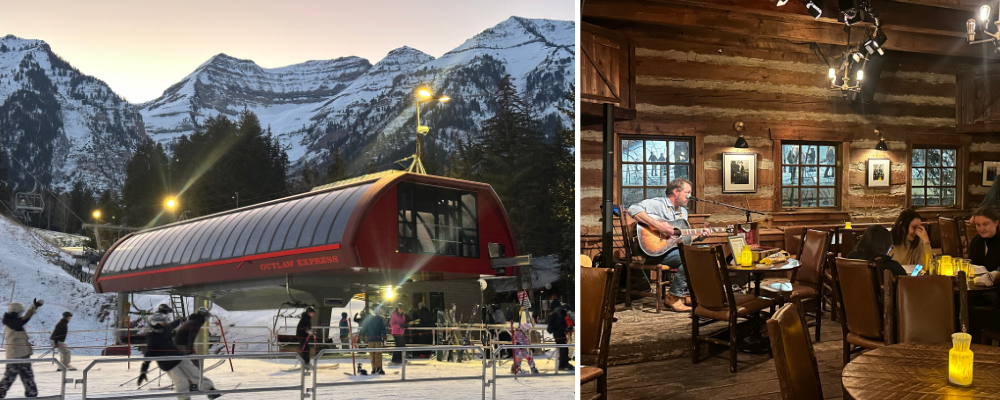 Left to right: Mt. Timpanogos behind the Outlaw Express lift; Owl Bar.
Story Time
By the time Redford’s hand-selected new owners took over five years ago in the middle of a pandemic, Sundance had dwindled to 120,000 skier visits and its winter operations were… endangered. The skiing and Redford’s diverse teaching labs (under the Sundance Institute banner, they concentrate on directing and acting, but the lineup includes the arts from glass-blowing to pottery) existed mostly, it seemed, to feed the renowned food and beverage operation.
This was particularly striking because just an hour’s drive away loomed one of the busiest, booming epicenters of mega-pass skiing, with Vail Resort’s Park City Mountain Resort plus neighboring (and now doubling in size) Deer Valley, the crown jewel of Alterra Mountain Company. Nearby are the Ikon Pass bastions of the Little and Big Cottonwood Canyons, home base to Alta, Snowbird, Brighton and Solitude. Together, they drew roughly 50-times the ski visitation of the actor’s tiny, mostly local ski area.
But under new ownership with access to real capital, a lengthy list of on- and off-hill improvements have helped Sundance more than double its visits, not from joining a mega-pass but by selling 17,000 season passes for roughly $800 each in Provo—catering mainly to locals but also wooing ultra-affluent visitors—and by delivering the personal touch to all. The locals lineup includes midweek and night season passes, and the $119 S-Card gets a free day of skiing and subsequent visits at $99 ($79 and $69 for children).
Interviews with dozens of patrons, from the customers to employees, show that the management balancing act is working, and the bottom-line results back it up. The locals are passionate about Redford and his ideals. Storyteller has changed things, but mostly just made them better. “They’ve been true to the ideals of Robert Redford” is the consensus.
Perhaps no one exemplified this view more than the young boot room valet I met at the Inn, one of 900 winter employees and a digital marketing major at Utah Valley. Asked to summarize Sundance’s social media presence, his answer is quick:
“Zero. It’s all word of mouth, the best way, the way it should be.”
All the New Toys
The makeover began with the installation in 2021 of the village’s first high-speed lift, the Outlaw Express (honoring 1969’s Butch Cassidy and the Sundance Kid), which cut the ride time by 15 minutes despite climbing 300 more vertical feet. It also provided access to the terrain and the singular views of what locals call the “back mountain,” where the scenery is arguably exceeded only by Telluride in this country. Meanwhile, the cramped beginner area went from worst to first, with three new magic carpets.
Sundance also created a 19-million-gallon water storage pond and increased its pumping capacity tenfold; it’s now up to 3,500 gallons per minute. The addition of an air/water system with 145 HKD Phazer guns plus 24 HKD fan guns and four SMI Pole-Cats spread the new wealth.
Like many areas in the West, snowmaking will get more attention after the drought winter of 2025-26, when less than half the area was open in early February. Storyteller will revisit the pros, cons and costs of expanding and extending its manmade capabilities up the mountain, since Sundance sits at a relatively low elevation. When it dumps at Snowbird or Alta, with bases above 8,000 feet, it can rain at the 6,100-foot base of Sundance. (The new 6,350-foot East Village at Deer Valley has similar elevation challenges).
Two Distinct Customers
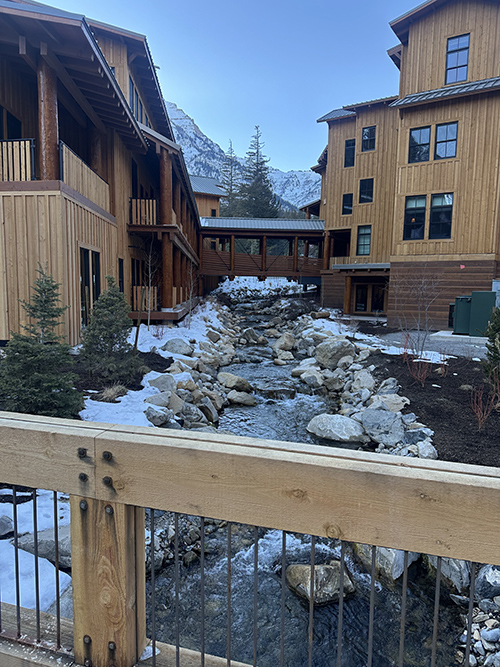 Inn at SundanceNext winter’s expansion is hotly awaited, and the opening of the Inn provides a critical cog in the overall plan, as it gives Sundance a total of 350 warm pillows for high-end customers, including a robust, year-round conference business. But Czar Johnson, the director of mountain operations, says the real “game changer” for the resort’s middle-class skiing base, and a big success for the bottom line, was the construction and opening last winter of the Mountain Camp day lodge. It is located uphill from the resort village via an access road and includes 1,000 wonderfully paved parking places (the resort village’s 200 spots are also paved).
Local flavor. Within the 9,000-square-foot Sprung structure, which has a 20-year lifespan, the day lodge houses all the skier service staples—lift tickets, lessons, rentals, a small retail shop, and of course a cafeteria, where you can find a good, hearty lunch for $12. This facility has been the true separator for the large Provo Valley crowd that is here to ski, while the overnight visitors can camp in luxury down in the village. Sundance might be called a boutique ski area, with rooms at the new Inn running more $1,000 a night and the dinner tab at the sublime Tree Room costing a small fortune. But the locals are the backbone and provide some 90 percent of the visits.
Smart financing. In constructing the $5-million Mountain Camp in one summer versus multiple building seasons for a more upscale, permanent lodge, the resort avoided the high cost (more than double) of a permanent facility, while buying time to determine what the future holds. Storyteller was able to issue a $45 million bond at a favorable market interest rate to pay for the Inn, for Mountain Camp, and for the expansion of maintenance facilities. The bond was quickly oversubscribed and sold out in three weeks. Storyteller eliminated the borrowing cost via property and lodging tax rebates hinged to military use at the Inn, which will host Wounded Warriors programming as an important part of its mission.
Being a private property has advantages, too. “There’s no way we could have gotten all this done over the past four years if we were having to navigate the USFS process,” Johnson says. That doesn’t mean Sundance isn’t focused on being environmentally sound, he adds, stressing its close relationship with the Sundance Nature Alliance.
Summer Box Office Smash
So let’s review the rarities: Paved parking (albeit with small fees on weekends and peak days, to encourage car-pooling); an untapped Western resort located on private land with extraordinary views (in Utah!); a winter business plan that depends on a loyal blue-collar-and-middle-class base but successfully caters to high-end big spenders; no notable pass affiliations; low bank debt; and a commitment to listen to customers and honor Redford’s past. These could all be resort anomalies, but this may be the biggest of all:
Summer is bigger than winter. Sundance's varied summer activities deliver more revenue and more EBITDA than the skiing, which is critically important but does not have to shoulder the P&L, particularly helpful in a drought year.
“We have the longest summers,” chuckles GM Linebaugh, who acknowledges the ski area would benefit from being 2,000 feet higher (as is true for many Utah resorts).
Those summers are indeed busy, not with the usual alpine coasters but with activities grounded in the outdoors, nature, and the arts. Besides the popular theatre, Storyteller’s Sundance has doubled the reach of the popular and unique Bluebird Cafe Concert Series in its 1,500-seat slopeside, outdoor amphitheater (with singer-songwriters straight from Nashville), and the Sundance Institute’s labs truly come alive when it gets warm. Redford’s passions (and films) focused on horses and fly-fishing (as well as downhill racing), and these pursuits receive world-class attention, along with hiking. There is, of course, a Redford Film Series, and Sundance was among the first to provide and promote lift-served mountain biking. The special events are endless, from Harvest Markets to Halloween Lift Rides, and there seems to be endless live music across the resort, as well as about 50 weddings last year.
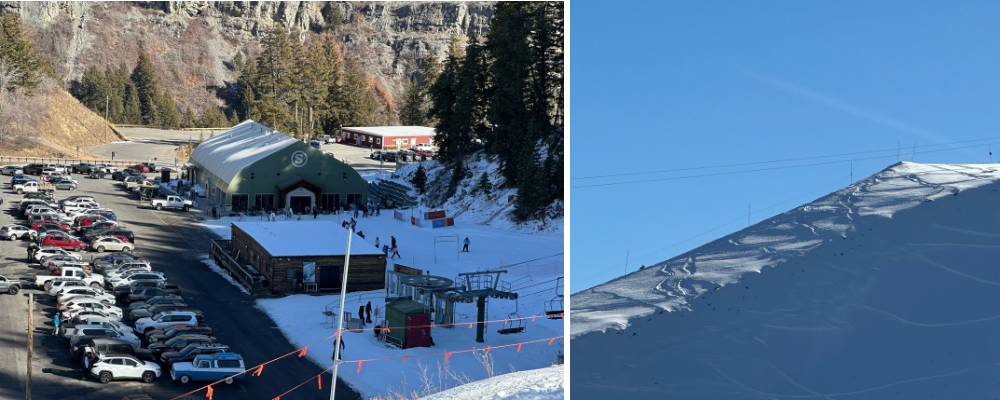 Left to right: Mountain Camp day lodge; Storyteller run.
When Private Equity Works
Private equity has become a four-letter word. These investments typically bring in cash and outside experts with the main goal of increasing an asset’s value over a pre-determined period, often 10 years, and then selling at a profit to the next owner. The goal is an upside in value and assets. But this is not always the best approach for the resort, the staff, the skier-consumer, the community, environment, and long-term health of the property.
When the equity partners are a proper fit, PE can be a very good thing, a much-needed injection of capital and expertise. And when the group includes someone with a Hall of Fame ski resort operations background and arguably the best reputation for smart stewardship, it can be superior to many other ownership models in place from coast to coast. Such is the case with Storyteller.
Bill Jensen, who is both an NSAA Lifetime Achievement Award winner and a U.S. Ski Hall of Fame inductee, came into the Sundance project through his longtime friend and colleague Philip “Flip” Maritz, whose career includes investments of some $7 billion, both from his own firm in St. Louis, where his family name is highly regarded, and also at Broadreach Capital. Maritz played the leading role in the purchase, spending almost two years with Redford before the environmentalist felt comfortable with Storyteller and its intentions.
Broadreach, formed in 2002, has breathed life into luxury hotel projects from the Park Hyatt in Sydney, Australia, to the Sunset Millenium in West Hollywood. It partnered with Cedar Capital, which brought its 20-year-plus track record and investments of $4 billion in high-end hospitality around the world. These luxe resorts range from the Savoy in London to the Monte Carlo Grand in Monaco, and include projects in Geneva, Amsterdam, Cannes, Rome, Budapest, Vienna and Paris. For Cedar and Broadreach, this is hardly their first rodeo—but they didn’t have a ski resort expert on their team.
A Master at Work
Jensen became a partner at Broadreach in this joint project with Cedar, thus birthing the new Sundance ownership group, Storyteller. A major challenge: the purchase price for the 2,600-acre Sundance property came at a premium, at least in traditional ski resort terms of a multiple applied to EBITDA. Obviously, Sundance is not just a ski resort (nor a typical one), and the buyer saw huge EBIDTA (and asset) growth upside. The package also included some lucrative real estate holdings.
Jensen concurred, invested his own hard-earned money in the Sundance project, and was designated to lead the efforts on ski area operations and the overall business plan, both of which are on pace. Everyone in this partnership has a role and an area of expertise, whether it’s construction, summer ops, arts, food and beverage, lodging, or real estate.
Jensen sits comfortably in the Inn’s throwback Living Room, discussing the survey returns from the 2024-25 NSAA Economic Analysis of U.S. Ski Areas—he was writing an overview and dissection for SAM’s March 2026 issue as we spoke. Keenly aware the West is now struggling through one of its most challenging seasons ever, he is still quite pleased to report that the snow industry's overall vitals in revenue and profitability are improving, despite an increase in labor and expenses in general.
He’s excited about this, but he's fixating on the Sundance challenge, and the next best moves. Squint your eyes and you can almost see him reflect on his own lessons, from loading lifts at Mammoth to becoming mountain president at Vail Resorts, CEO at Intrawest, and being the people’s choice at Telluride, where he elevated that resort to a No. 1 ranking.
Jensen is now clearly focused on Sundance, and its future is in very good hands.
Chronicling big and small resorts for more than 40 years, Andy Bigford is the former editor-in-chief of SKI magazine. He has written and/or edited six books, including collaborating with the late Chris Diamond on the Ski Inc. book series. He is at work on a third Ski Inc. edition for publication in late summer 2027. The next stop in his Revival Road Trip is with Rick Schmitz and his trio of Wisconsin resorts.