

The ski industry in North America faces a significant challenge: nearly half of its lifts are at least 30 years old. That means resorts must adopt more rigorous maintenance regimens and plan for eventually replacing these lifts. However, rising prices, limited means of financing, and a reduction in the number of used lifts entering the market make replacement difficult.
This is not new news, of course. Resorts have been aware of it for two decades at least. As each year passes, though, the situation has become more acute. During a SAM roundtable discussion in mid-March, Peter Landsman, editor of liftblog.com and a lift supervisor at Jackson Hole Mountain Resort, Wyo., quantified the magnitude of the challenge.
The math is pretty simple. Approximately 6,700 lifts (6,682 by Landsman’s count) have been built in the U.S. and Canada since 1935. Of those, about 44 percent (2,947) are still operating. And of those, just under half (1,287) are more than 30 years old, though Landsman notes that the ages of some lifts are not known. More than 500 are at least 45 years old: 178 were installed in the 1960s or earlier, with another 350 or so dating to the 1970s. The 1980s and 1990s each saw about 500 lifts installed.
If North America’s nearly 3,000 lifts were to be replaced at 40 years old on average, Landsman notes, resorts should be replacing about 75 lifts a year. Last year, resorts installed 37 new ropeways (chairs, gondolas, platters, T-bars), 23 of which replaced existing lifts.
The State of the Installed Base
Of the older lifts (30+ years in service), 90 percent are from seven manufacturers:
- Doppelmayr — 265
- Hall — 200
- Riblet — 168
- Borvig — 140
- Yan — 129
- Poma — 126
- CTEC — 126
Geographically, Colorado, Utah, Montana, and Wyoming have the newest fleets, while the Northeast, Midwest, and Canada have the oldest. There’s not a lot of variation among these regions, though—aging lifts are industry-wide.
Not all old lifts were created equal, of course. Detachable lifts, especially the first generation, tend to have a shorter lifespan than fixed-grips. And among fixed-grips, Yan lifts are known for being solid and very reliable (especially those with steel sheave assemblies). Hall, CTEC, and Partek lifts have aged particularly well also. Some others, like Riblet, are more challenging.
Climate also impacts how well lifts age. In relatively dry locations, like much of the Rockies, rust and corrosion are less common than in regions with wetter climates, like the Pacific Northwest or the Mid-Atlantic. Wetter climates are also bad for electronics.
Operating hours are a factor. The conventional wisdom is the more a lift runs, the quicker it ages. So, running for night skiing or summer ops could negatively impact the lifespan of a lift. But a lift that sits a lot or doesn’t run at all for a few years ages more quickly, too, says Landsman. Operating hours cut both ways.
Maintenance matters, too. Perhaps the biggest factor in how fast a lift ages is maintenance and the resources the operator has during the life of that lift. A lift at a resort with a lot of experienced staff and money for spare parts and midlife upgrades might age better than one at a resort with a lot less of each.
The Replacement Challenge
Eventually, no matter how superb the maintenance, lifts must be retired. This is not just an issue for smaller or independent resorts. According to Landsman, the data show this is a problem at every size resort and every ownership structure. Vail Resorts and Alterra Mountain Company, for example, have a big challenge with aging lifts, as they have the biggest installed base. Vail in particular has nearly 300 lifts in the U.S. and Canada. It replaced one in 2025 and is doing three this year, Landsman notes.
At the other end of the spectrum, independent Sunlight in Colorado installed one brand new and one used lift (relocated from Arapahoe Basin, Colo.) for 2025-26, out of three lifts total. And Little Switzerland, Wis., is installing two new lifts this summer to replace one of its two “up and over” lifts.
Operator Perspectives
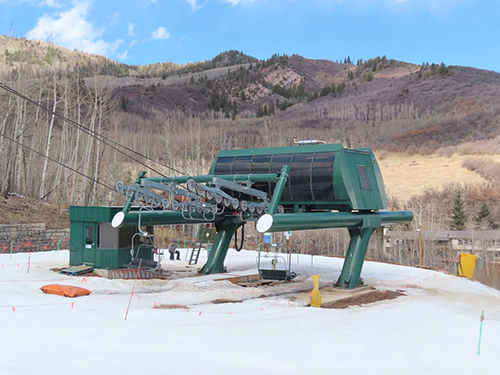 In 2025, Sunlight, Colo., replaced a 70-year-old Riblet/Heron hybrid, which began life at Aspen before moving to Sunlight in 1973, with this 2001 Poma triple relocated from A-Basin, Colo.Operators see lift aging as a continuous issue, and face challenges balancing maintenance, replacement, and staffing. In addition to Landsman, operators on our roundtable included John Ball, general manager of Snow Valley Resort, Ontario, a member of the Lift Advisory Committee of the Technical Standards and Safety Authority (TSSA), which presides over lift standards in the province; Matt Vohs, general manager of Cascade Mountain, Wis., vice chair of the ANSI B77 committee and chair for the aging lifts subcommittee; and Mark Fischer, CEO of Pacific Group Resorts, with six ski areas and more than 40 lifts. All have lifts of varying ages, including some that are more than 50 years old, and know the issues related to aging lifts intimately.
Age is a state of mind. A lift starts aging “the day after it’s installed,” Ball says, noting that none of Snow Valley’s chairs “are in OEM (original equipment manufacturer) condition,” the ski area having replaced grips and carriers, and on one lift, a drive.
Vohs notes that age is in the eye of the beholder. “We just had a young new engineer from Leitner-Poma tell us the other day, when he was logged into one of our lifts that’s only ten years old, that he’s never worked on a low voltage control system this old. We were quickly reminded that a young lift in our eyes is potentially an aging lift in somebody else’s.”
Needed: caregivers. The need for professional and qualified maintenance technicians is high.
“As the lifts get older, they seem to develop idiosyncrasies,” Fischer says. “So, we try and get an apprentice on those lifts several years [before the veteran mechanics retire].
“Lift mechanics are hard to come by,” he adds. “The ability to get people who are willing to dig in and learn that skill is becoming very price competitive.”
Engineers in the industry see this as well. “It is a widespread issue,” says Alberta-based Brian Bain, a project engineer at
McElhanney. In Western Canada, he notes, most resorts are in small towns where it’s difficult to retain staff who really know the equipment. A resort’s ability to operate aging lifts efficiently “is heavily dependent on the staff they have and the knowledge and experience they have with their lifts,” he adds.
That sentiment is widespread.
Planning for Upgrades
With the high cost of new lifts, resorts have to plan several years out for eventual replacement. But those plans can be delayed due to uncontrolled variables such as a bad weather year or a financial crisis, says Vohs.
So, a balance must be struck between the operational realities of running old lifts and the need to grow business enough to support investing in new lifts. “If we’re ever going to be able to afford to replace these lifts that are fifty-plus years old, we’ve got to make sure we’re financially stable enough,” says Vohs. Part of that, he says, is increasing both business volume and capacity. “It’s a fine line that you have to walk to be able to expand your territory and your customer base but also be replacing lifts both for customer satisfaction and for maintenance and safety needs.”
Rising costs. That type of planning is not easy. In the last five to 10 years, “the capital cost for replacing or building a new lift more than doubled,” Vohs notes. “That’s drastically changed the formula when you’re looking at maintenance costs versus your cap ex on a new lift.”
Lift manufacturers note that Covid-related supply chain disruptions and the more recent tariff hikes on steel contributed to a 40-45 percent rise in prices over the past six years. Construction costs are also up 40 percent over that time frame, says Leitner-Poma of America director of sales Michael Manley. And during the first month of the war with Iran, he adds, steel prices jumped another 10 percent. That all impacts the price of a new lift.
“Overwhelmingly, it’s cheaper to maintain a fifty-year-old Hall as long as you have the proper personnel in place,” Vohs concludes. “The variable you can’t really quantify, though, is that risk of age-related failures. It’s hard to quantify the cost both on the liability side and on repair and maintenance.”
Acquiring capital. Fischer notes that financing options are limited at best. “Currently the best you can get might be a five-year equipment loan. I learned early that you don’t do a short term loan for a long term asset. A ski area earning seven million dollars in revenue is not going to get a five-year loan for a seven- to ten-million-dollar lift. The numbers and timetable don’t work.”
Lenders aren’t familiar with the industry and won’t offer longer financing terms because they say there’s no secondary market, says Fischer. “A lift does not look like a moveable, resaleable piece of equipment to them.”
Skytrac president Carl Skylling says that his company has “approached different financial institutions to try to set up a way of financing lift equipment,” without success. The company even offered to guarantee it would, in case of a default, “revisit that lift, remove it, remarket it, and resell it.
“But even the best potential model that we’ve been able to come up with, it’s too much risk for these financial institutions.”
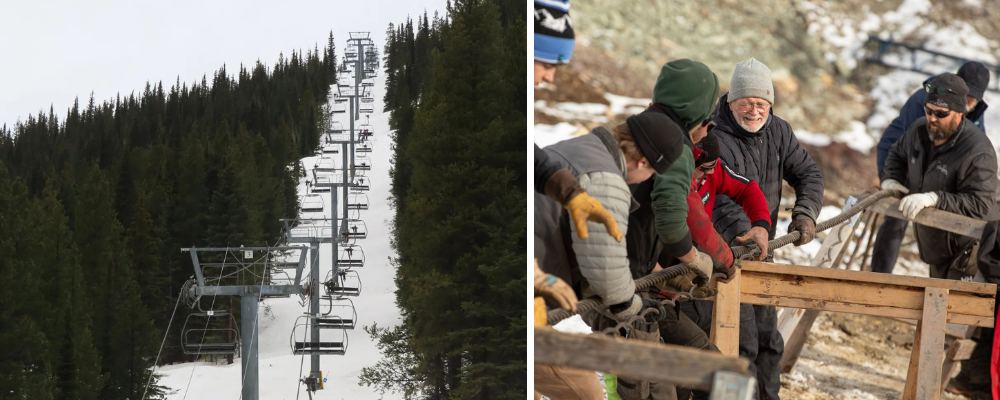 Left to right: Last summer, Castle Mountain, Alberta, installed an updated 1988 Poma detachable quad relocated from Sunshine Village to serve terrain previously accessed by snowcat only; Splicing the the lift’s rope.
Maintenance vs. Replacement: The Ontario Example
At Snow Valley, the thinking about aging lifts is a bit different. The province of Ontario has a comprehensive inspection program for lifts that are 25 years old or more, which gives resorts more confidence in operating older lifts and keeping them running, rather than thinking about replacing them.
“For us it’s a lot easier. Instead of looking at the cap ex and the forwarding costs of buying a new lift, we are planning for the next engineering review, which take place every five years,” says Ball.
“When you have mechanics working on a lift that has a dedicated task list to complete for the engineering review, they become much more familiar with that lift and every component on it, because essentially every five years you’re taking it apart and putting it back together again with as-built or better parts,” he explains.
(SAM will report on the Ontario program—both for lift maintenance and mechanic training, and the potential to bring some of that guidance to U.S. resorts—in an upcoming issue.)

That level of rigor in maintenance is one all resorts should embrace, says Bain. “You should know the condition of every piece of equipment on your lift,” he says. “Every hill should be going through some process of looking at every component. If you don’t, then you should be planning on how to look at that.”
Lift Relocations and Refurbishments
If continued maintenance is no longer feasible or practical, used and refurbished lifts remain a logical option to buying new. Finding a suitable lift, though, requires a lot of looking, a rigorous inspection, and a full understanding of risks.
Fewer suitable lifts are available today than 10-20 years ago. In some cases, a resort, especially a larger one, may not want the liability for the lift after it’s sold. In others, the original manufacturer may not want to guarantee parts availability or bear the design liability. And in still others, a resort might be able to auction off the chairs to its fans for more than the resale value of the entire lift. Timing is also an issue. Manley notes that when a resort removes a lift, it may not have a place to store it until a buyer turns up.
Even if a suitable lift can be located, Bain believes the cost differential between a relocation and a new lift is often “so small that it becomes harder and harder for a ski hill to want to take on the effort,” which is often a greater commitment than they expect. “They need to understand how much internal effort is going to go into it and if they’re ready for that, because everybody’s already busy just keeping their hills running.”
Landsman nonetheless urges better communication to redirect high-quality used lifts to operators in need, particularly since there’s not enough lift-building capacity to replace all the aging lifts with brand-new ones—even if resorts could afford to do it.
One positive example: Leitner-Poma is involved in helping PGR move a detachable quad from Aspen to Powderhorn (which is less than an hour from Leitner-Poma’s home in Grand Junction) where it will replace a fixed-grip double that’s more than 50 years old.
Finding a suitable lift. Vermont-based Bobby Farrell of Elevation Engineering believes the right used lift can be very cost-effective, but finding one takes effort. “It’s like buying a used car,” he says. “You can’t just decide you’re going to buy a used Subaru Outback with 100,000 miles on it. You have to pick and choose.
“When we’re looking at relocating a lift, the potential for internal corrosion in hangers or in tower tubes and cross arms are cause for concern,” Farrell adds, especially for lifts from wet climates.
If a used lift passes the basic soundness tests, he says, “you go through a complete inspection of the lift, replacing all the pins and bushings, bearings, and other wear items,” to reduce the potential for failure. Most relocated lifts will also need new drives and electronics to meet current ANSI B77 standards.
All three lift manufacturers told SAM their support for any lift relocation stems from just this sort of analysis, along with an assessment of how available parts will be in the future. “We try to support them as long as we can; it has to make economic sense,” says Doppelmayr CEO Keith Johns. “For a sheave hub from 40 years ago, for example, the mold cost is likely prohibitive.”
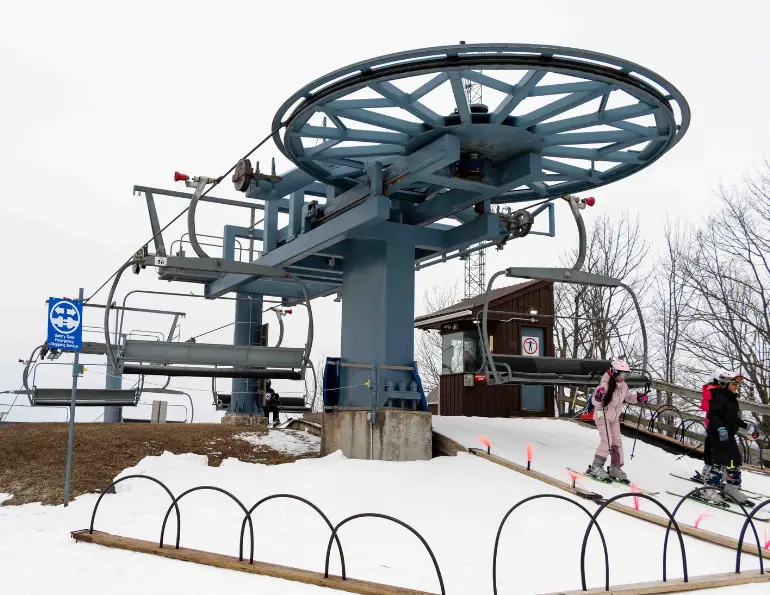
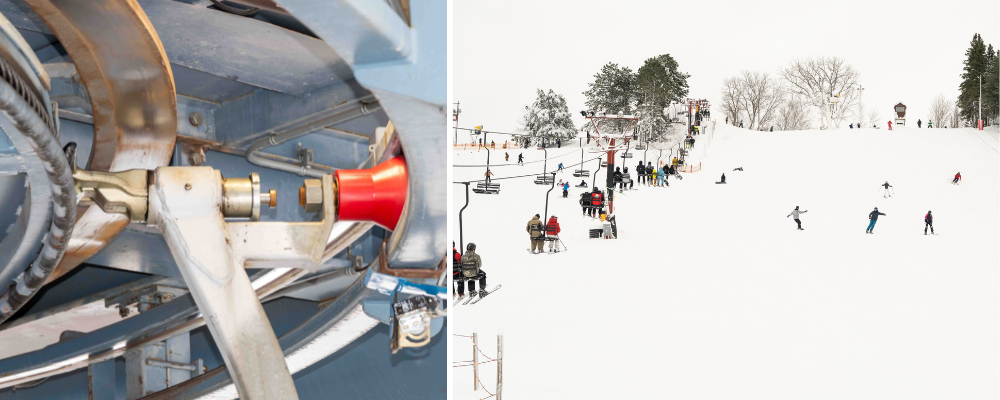 Left to right: The 1997 Snow Valley (Ont.) BM/Leitner six-place fixed-grip, the only such lift in North America, has seen several refurbishings, including new grips in 2014 (made by BMF-AG); Little Switzerland, Wis., is replacing this 1964 “up and over” Riblet, the first of its kind in North America, with two new Skytrac quad chairs this summer. The upgrade will double uphill capacity.
Are Lower-Cost Lifts Possible?
While some, including Bain and Skylling, believe the basic fixed-grip lift already exists, others believe there is a market for a simpler, bare-bones fixed grip lift that could balance replacement needs with financial realities. “I think that would potentially be a good selling point to a lot of these smaller areas that don’t necessarily need all the options that come with some of the newer stuff now,” Farrell says.
Modular lifts? Fischer asks, “What if we could manufacture modular lifts, like an erector set? Right now, the terminals are getting bigger, requiring cranes for installation and huge trucks for shipping.” Modular lifts would be easier to install and move, and likely, to maintain.
Skytrac’s Skylling sympathizes, but doubts there’s much that can be done to lower costs. Hall lifts were modular and lent themselves to DIY installation, he notes, but current standards make installation more complex, as the ANSI B77 code requires “detailed submittal packages,” he says.
Skylling points out that Skytrac was founded on the idea of refurbishing existing lifts, and moved into manufacturing lower-cost but robust new lifts only after it became clear that was the best way to meet the industry’s future needs. And it has been careful to avoid feature creep that would increase costs. “We (Skytrac) are about as bolt-together as you could probably get,” he says.
Both Leitner-Poma and Doppelmayr also do pre-assembly at the factory to minimize on-site construction and keep a lid on costs. “We pre-manufacture them so they are like an erector set already,” says Doppelmayr’s Johns.
That said, Skytrac does manufacture “heavy” equipment, Skylling says; in vehicle terms, its lifts are more Ford F-250 (LT trim, not Platinum) than, say, base 2010 Subaru. Could there be a market for that lighter Subaru-esque lift?
Fixed-grip lite? “Someone could introduce a lighter-weight lift,” Skylling says. “Lighter weight in terms of structure, cross arm design, tower design, chair design, and feel.” But it’s likely, he adds, they would eventually experience the same issues that have led manufacturers to build heavier equipment.
Plus, the design parameters would limit a lighter lift’s capacity and ability to expand if demand increases. “You’re not going to be successful selling lifts if you can’t meet those [demand] requirements,” Skylling says.
In addition, he adds, it’s tough to meet “all the current ANSI requirements, which have gotten more stringent, and still meet all the Annex J control system requirements,” and more. The F-250 lift exists for good reasons.
A bare-bones option? At the urging of Welch Village co-owner Leigh Nelson, Doppelmayr did manufacture a stripped-down model, the Eco Drive, from the early 2000s to 2015. It had a simple drive terminal with minimal enclosures, but the company sold just 10-15 of them, says Johns. “It didn’t take off in the market like we thought it might,” he notes.
Buy new in phases? Instead of pursuing a less expensive fixed-grip lite, Skytrac often urges resorts to do a phased replacement: a new drive tension terminal first, then upgrade all the other equipment five or so years later. But there can still be complicating factors, such as the line gauge of the existing equipment, which limits future capacity. The devil’s in the details.
The Glass is Half Full
In spite of the challenges, most industry players remain optimistic about the future of uphill transportation, whether the issue is availability of mechanics or affordable lifts.
Price stability. “The number of lifts that are going to be installed this year is definitely down,” Landsman says, which could help lower pricing. “MND is obviously trying to be a third manufacturer, and competition always helps hold prices down,” he adds. There’s some evidence that lifts are more affordable this year for smaller and independent resorts.
Growing talent pool. NSAA’s Mike Lane sees positive momentum from ropeway technician training and manufacturer hiring. An apprentice program of some sort for mechanics seems likely, perhaps by the end of this year, which will help fill the talent pool. Doppelmayr is building a new facility that will include a training space that will be equipped to do online training as well. Leitner-Poma’s Manley believes that AI and video will help identify maintenance issues before equipment fails, thus making maintenance efforts more efficient. “The urban side of the business will drive that, “ he says.
An increase in manufacturing capacity. Skylling notes Skytrac has recently expanded, and can increase its production beyond the 25 percent increase he foresees for 2027.
There’s been talk about setting up a co-op lift company to build affordable lifts, and some individuals have expressed a desire to do that themselves. Watch for signs.
Summing up the current sentiment, Skylling says, “I really wish I had a solution, but just chipping away is about the best I’ve come up with at this point.”