



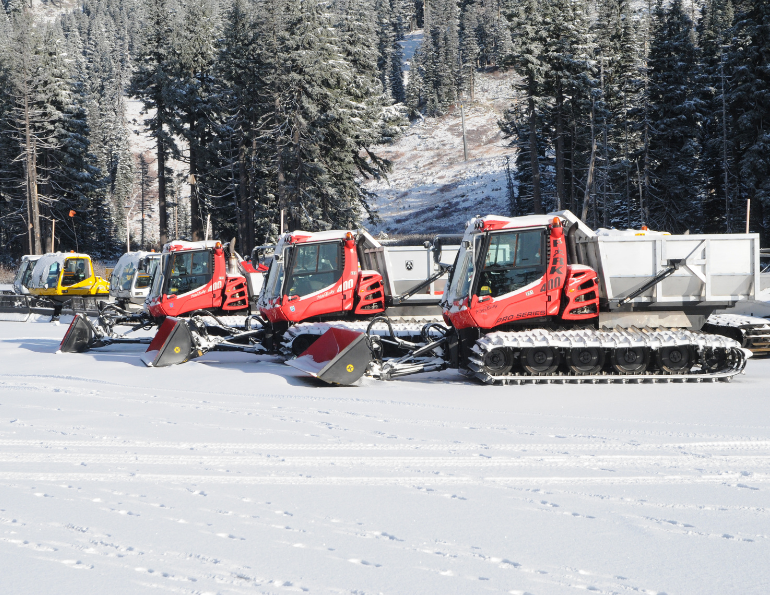
In case you hadn’t heard, a prolonged snow drought started early in the season and led to delayed openings for most ski areas in the West. According to a March report from the National Integrated Drought Information System, several states, including Arizona, Colorado, Nevada, New Mexico, Oregon, Utah, and Wyoming, experienced their warmest winter on record, which contributed to the lowest snowpack in decades for much of the West. A challenge, of course, but problem-solving is not a new concept for our industry.
Since this wasn’t the first time a season started with lean snow, some ski area operators had strategies and processes already in place to find, move, and preserve the snow they did have, and others discovered new ways to do the same.
Monarch Mountain: Harvesting the Wind-Blow
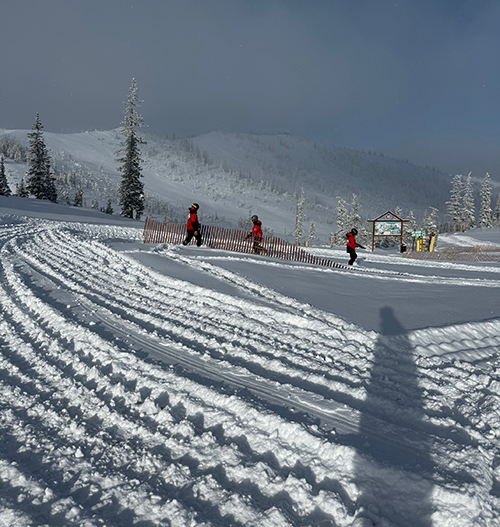 Patrollers at Monarch Mountain install temporary snow fencing before storms hit in places where wind will load the leeward side of terrain. Monarch has no snowmaking and relies entirely on capturing natural snowfall to open and operate.Topping out at nearly 12,000 feet, Colorado’s Monarch Mountain straddles the Continental Divide, where storms, wind, and geography combine to create a phenomenon locals call the “Monarch Cloud,” which often delivers snow when other areas nearby have dry skies.
For the Monarch mountain operations team, the challenge is capturing it.
The ski area relies entirely on natural snowfall, which has shaped its snow farming strategy, refined over decades to capture and concentrate both falling and wind-blown snow across the mountain.
Permanent wooden snow fences line ridgelines and wind corridors across Monarch’s terrain. During lean years, those barriers are supplemented with portable fencing placed exactly where wind patterns concentrate drifting snow. “We’re maximizing active snowfall and wind-blown snowfall,” says general manager Chris Haggerty.
Before storms hit, ski patrol leads “fence parties” to install fencing where wind will load the leeward side of terrain. “Everybody in mountain ops is out there putting them up,” Haggerty says.
This season, as early winter forecasts signaled trouble, Monarch purchased every temporary snow fence—standard wood-slat with interwoven wire about 4 feet tall and 50 feet in length—it could find locally, deploying roughly 50 additional sections before the holidays in December.
Movable fencing. As the dry pattern persisted, the team built another 30 movable fences in-house. These structures—roughly 15 to 18 feet wide and 8 to 10 feet tall—were designed specifically for snowcat transport, allowing operators to respond in real time to shifting wind direction and storm patterns. “We can pick them up with forks on the blade, and move them where we want,” says Haggerty.
Institutional know-how. The system works because Monarch’s veteran operators know the mountain intimately. Some have spent more than two decades studying how wind funnels through specific gullies and ridges. Even when it’s not snowing, winds can transport snow from surrounding valleys, piling it against fences where groomers later redistribute it across trails.
The payoff this winter was significant. By Dec. 22, when most Colorado ski areas were barely open, Monarch was skiing and riding on more than 50 trails. From the holidays on, it operated with 85–90 percent of its terrain open and snow farming helped the ski area to debut its No Name Basin terrain expansion on Jan. 28. Monarch was able to stay open until March 29 on a season total of 112 inches of snow—less a third of its annual average.
For Haggerty, the lesson is simple. “There’s not one solution out there,” he says. “It’s about maximizing every flake.”
Arapahoe Basin: Snow Squirreling
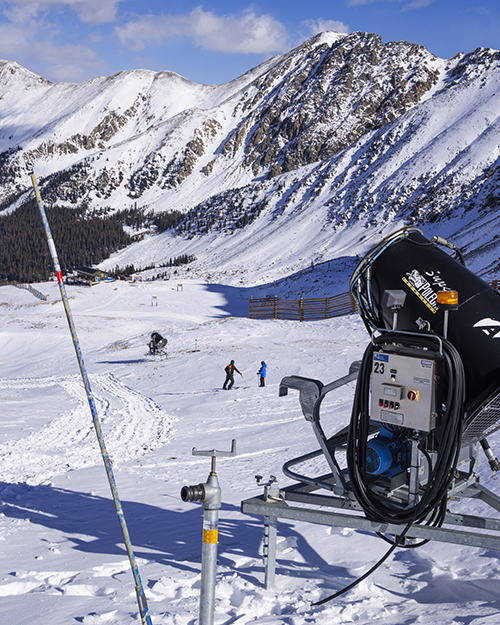 A-Basin’s snowmaking lays down a durable base in the fall, while permanent snow fencing serves as “passive snowmaking” all winter long, collecting snow deposits in known wind corridors.Arapahoe Basin in Colorado’s Summit County is historically one of the first ski areas in the United States to start spinning lifts each fall and last to close each spring. “For generations, we’ve tried to give people the most skiing we safely can,” says VP of mountain operations Louis Skowyra.
The surface management strategies that allow A-Basin to stretch the ski season each year also support operations in lean winters.
In the fall, snowmaking—introduced in 2002 and limited by water availability—lays down a durable base. Snowcat operators spread early snowmaking piles thin and wide, sometimes just a few inches deep, creating what Skowyra calls a “toehold” that natural snowfall can build upon. Then, “when it snows, we pack it out,” he says, “with ski patrollers in their boots, with the snowcats, and with a compaction roller that hooks onto our winch cat.”
A-Basin also capitalizes on, and minimizes the negative effects of, wind that blows through the high alpine environment using nearly two miles of permanent snow fencing, or “passive snowmaking,” as Skowyra calls it.
Placed in strategic wind corridors, A-Basin’s snow fences play a critical role in whether key terrain opens at all. “We have them in areas we know are going to get polished off by the wind unless we do something to disrupt that wind pattern and deposit the snow where we want it,” says Skowyra. “They’re a gamechanger in certain areas. Certainly, on the south side of our mountain. The southerly aspect in Zuma Bowl, we wouldn’t be skiing back there if it weren’t for permanent snow fencing.”
Throughout the season, the grooming team spends time “squirreling away snow,” as Skowyra puts it, by stashing it in places from which it can be retrieved when coverage gets thin. “We have guys who've been doing this for 45 years,” he says. “So, they know where the snow is, they know where to stash the snow, and then subsequently know where to find the snow in the spring.” Or in the case of the 2025-26 season, in the heart of winter to cover bare spots as fickle snowfall persisted.
In spring, crews narrow wide trails into corridors, essentially folding the snowpack to double its depth to keep key routes open.
Technology is beginning to supplement decades of institutional knowledge. The ski area is preparing to adopt the Prinoth Connect Snow Measurement system to improve the current snow depth measurement process, which mostly involves Skowyra “out there with an avalanche probe just zigging and zagging and stabbing like an idiot,” he says. The technology more precisely measures the snowpack and minimizes the learning curve for new snowcat operators. “They don’t have to slam into the same rock that we’ve polished off over the last 50 years with our machines.”
Whether the winter is lean or generous, A-Basin’s goal is the same: manage the snow carefully, protect the base, and keep the lifts turning as long as possible.
Mt. Hood Meadows: Farming the Parking Lot
Lean years have forced Oregon’s Mt. Hood Meadows to rethink how it builds and maintains early-season coverage. “We’ve been blessed with ample to abundant snowfall for most of the resort’s history,” says grooming manager Rob Gayman. “To the point that, looking back, some development happened with a bit of a cavalier attitude toward operational snow needs.” For example, some runs were never stump-ground. Lift terminals and buildings were constructed for deep natural bases. Several creeks and terrain dips require snow bridges.
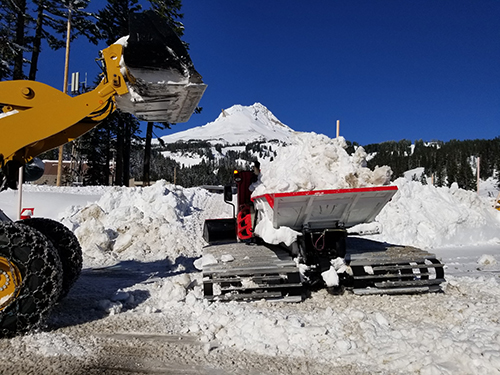 Mt. Hood Meadows converts three PistenBully 400s into haulers every summer to support early season snow harvesting from its parking lots. This year, operators harvested snow throughout the season to supplement low-tide conditions.“All of that works great when the Cascades deliver,” he says. “But we still have to meet those operational snow-depth requirements even when there’s less fresh snow to work with.”
“Snowmaking isn’t the slam dunk in the Pacific Northwest that it is elsewhere,” Gayman adds. “Wet-bulb temperatures are marginal, freezing levels fluctuate, and we don’t have large water storage.”
Instead, the resort’s large, state-permitted parking lots have become a critical snow reservoir. Rather than clearing them early in the season, Meadows coordinates with the Oregon Department of Transportation to leave snow in place. The first round of snow in the fall gets scraped off to clean the pavement of gravel. Then the snow is piled in strategic locations close to the access ramps out onto the slopes. From there, the operation shifts into hauling mode.
Tools for the job. In the summer of 2014, Meadows’ mechanics and fabricators built a tow-behind dump trailer on a retired BR350 chassis. It did the job but was cumbersome, says Gayman. So, the team outfitted a PistenBully 400 with a dump bed and snow bucket from PistenBully, converting it into a purpose-built hauling machine for the early season. “That turned out to be the sweet spot,” he says. “It had the maneuverability we needed but still carried a useful load.”
Meadows now has three snowcats equipped with buckets and dump beds. Mechanics convert those machines into haul cats during the summer. When terrain coverage expands, some of the fleet is typically converted back to standard grooming configuration with tillers and blades, often around late December, Gayman says.
This season, however, only one of the haul cats was converted back to a groomer—in mid-January. The other two remained configured for hauling for most of the winter.
From lot to lift. A single haul-cat dump bed carries roughly the equivalent of three loader scoops. With a fourth load in the haul-cat’s scoop, crews can move substantial amounts of snow with each trip. Cycle times range from a few minutes to more than 15, depending on haul distance and terrain. Lift ramps, connectors, and “routes that allow people to move around the mountain” are prioritized, Gayman says.
The team has adopted practical solutions to improve efficiency, such as coating the inside walls of the dump beds with vegetable oil using a pump sprayer to prevent snow from sticking.
“This year, hauling has been an all-season-long tool,” Gayman says. “From day one, we hauled to the lifts. We built and maintained our travel paths with hauled snow, padded thin and bare spots all season, and filled water holes.” Hauled snow also supported late-season efforts to maintain egress from advanced terrain and keep key connections skiable.
Snowbasin: Bagging Winter
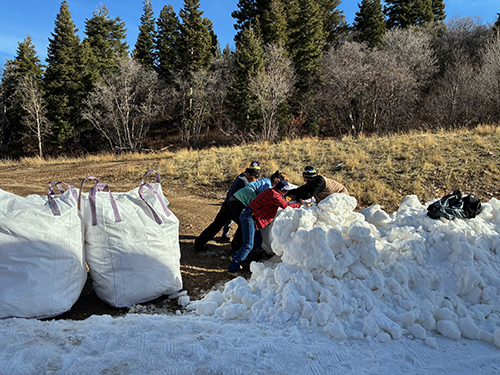 The Snowbasin team filled harvested snow into grain sacks that were transported around the resort and dumped in critical areas.At Snowbasin, Utah, warmer temperatures narrowed snowmaking windows and forced COO and general manager Davy Ratchford and his team to rethink how to build and maintain early-season coverage.
The solution? “We found these really neat grain bags,” says Ratchford. “We’d go to areas of the mountain where there was snow—corners, tree fields, places you couldn’t really ski—and shovel it into these big bags. Then we’d move them strategically all around the resort.”
Crews from across the mountain, including patrol, grooming, snowmaking, parking, and mountain safety, filled hundreds of bags—a true all-hands effort, coordinated every day.
The grain sacks, each roughly five feet high, five feet wide and five feet deep, contained about 125 cubic feet of compacted snow. Each full bag was placed on a pallet and transported using forks on a snowcat blade to critical areas like lift ramps and trail connections.
The work was physical, but spirits remained high. “It was a Herculean effort,” Ratchford says. “When Mother Nature wasn’t delivering, the Snowbasin employee spirit did.”
Culture-building. In a typical year, Snowbasin receives roughly 325 inches of annual snowfall. This winter the resort tallied just 124 inches. For Ratchford, though, the season became less about snow totals and more about culture. He frequently reminded staff that difficult seasons create the stories ski industry veterans tell decades later. “I kept telling my team, ‘This is the stuff you’ll talk about 20 years from now,’” he says.
Guests appreciated the effort. While snow-quality scores dipped during challenging periods, service scores actually increased, helping Snowbasin maintain its historically strong Net Promoter Score.
“The main battle we won,” Ratchford says, “was that our guests saw the effort we were willing to put in.”
For Snowbasin, the takeaway from a difficult season was simple: great skiing depends on snow, but great guest experiences depend on people. And when conditions got tough, the Snowbasin team leaned into the resort’s long-standing ethos: “Whatever it takes.”
A Practical Playbook
These approaches are born from the pressure cooker of necessity, supported by experience and a willingness to experiment. The result is a playbook of practical innovation—simple in concept, demanding in execution—that keeps lifts spinning and guests skiing, even when snowfall comes up short.
For a look at over-summer snow preservation, check out “Storing Snow Through Summer” (SAM, March 2026).