



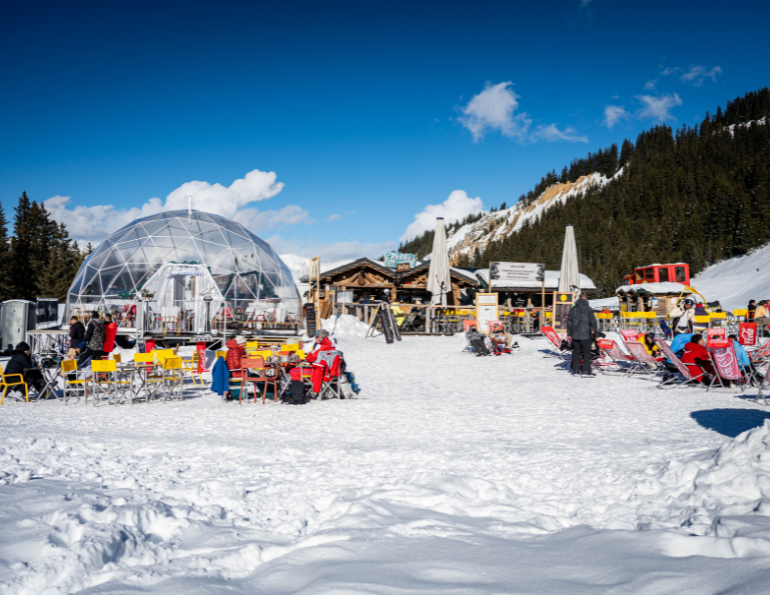
European countries such as Switzerland, France, Austria, and Italy have long been hotspots for skiing and riding. But in the last five years or so, U.S. skiers have been heading across the pond in droves, fueled by perceived value, capacity management, and destination experiences.
At the beginning of the 2025-26 ski season, ski trip booking platform Ski.com reported that European ski vacation bookings by U.S. travelers were up 45 percent from the previous season. And Méribel, a popular village and ski area in France’s Les 3 Vallées, reported 96,250 overnight stays from American visitors during winter 2024-25, up from 40,243 just two years prior.
“In the past, skiing in the Alps would be a bucket list trip,” says Cat Iwanchuck, vice president of business development for Ski.com. “But now, someone who has booked a moderately-priced trip to Colorado or Utah can compare prices to destinations in Europe and find similar price points, if not more value and cost savings. And when you layer the cultural aspect, there’s extra value.”
Iwanchuck adds that the rising popularity of multi-mountain passes has led to a “tickets are already paid for” mentality, making it easier to justify the trip. Not to mention, the price of skiing in the States is skyrocketing.
U.S. ski areas, it seems, are rarely able to offer the iconic destination, bang-for-buck, and capacity management pieces simultaneously. While to the consumer, European resorts appear to have it all: expansive terrain, efficient lift systems, delectable food, charming villages, and uninhibited views. At destinations like Les 3 Vallées, 160 aerial lifts connect more than 600 kilometers (about 373 miles) of pistes across seven ski areas, which span multiple valleys and villages—and lift tickets are around $90 per day. In comparison, single-day tickets for the largest North American ski areas—all a fraction the size of the largest in Europe—regularly exceed $300 per day, even when purchased in advance.
The Uphill Experience
According to Eric Bonnel, managing director of SETAM, one of the four lift operators at Les 3 Vallées, the modern lift infrastructure is an indirect, yet critical, draw for U.S. skiers. “European and American skiers don’t really care about [lift infrastructure], so it isn’t important to promote it,” he says. “But when they see how modern our lifts are, that there are no lift lines, and it’s quick to go uphill, they’re happier about spending money on a pass.”
Frequent upgrades. On average, SETAM replaces one 15-million-euro chairlift every other year, and often upgrades high-speed chairlifts to gondolas to increase capacity. In Val Thorens, where SETAM operates its lifts, lift capacity surpasses 70,000 passengers per hour, despite the resort having only 25,000 beds and around 15,000 skiers on the slopes at any given time.
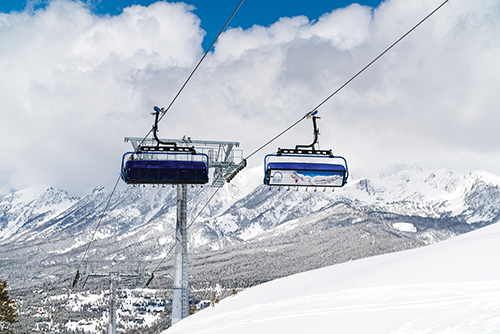 Big Sky’s (Mont.) eight-seat Ramcharger install was inspired by the lift trends in Europe.Unlike in North America, where the ski area owner or operator usually manages all operations and business lines, European lift companies focus primarily on uphill transport and typically share revenue across a connected domain. “So they have to be competitors, but they also have to work together,” says Vincent Lalanne-Clouté, the general director of the Val Thorens office of tourism. “This means the experience is really smooth—there’s no queue anywhere.”
That dynamic helps drive reinvestment. The four lift companies operating in Les 3 Vallées have a combined total of around 200 million euros in planned lift infrastructure investments over the next few years, according to Lalanne-Clouté.
High capacity. Boyne Resorts president and CEO Stephen Kircher observed a similar dynamic on a trip to Lech, Austria, where lift revenue is distributed based on scans, which incentivizes operators to invest in lifts that guests want to ride. The result is a system built for volume—high capacity supports high visitation, which in turn allows for lower ticket prices—and for comfort, he says.
The advanced infrastructure Kircher saw on several trips to Austria helped inspire massive investments at his own properties over the last decade. “There were 47 eight-place chairlifts operating in Austria when we installed the first one in the U.S. at Big Sky in 2018,” he says.
The company was looking to get ahead of the need to replace aging lifts that is currently plaguing many operators and felt that embracing the latest lift technology, specifically the Doppelmayr D-Line, would be a differentiator in the domestic market.
Boyne Resorts has long looked toward Europe to inform the experience at its U.S. ski areas. “I would argue that the Alps have some of the most forward thinking and mature mountain environments,” says Kircher.
More Than Skiing
The cultural experience, the walkability of mountain villages, and, more importantly, the food, are major drivers, too. And while there are exceptions, U.S. ski areas aren’t typically known for their culinary delights.
Differentiated dining. On-mountain dining is a very different experience in Europe, in part because of food’s cultural importance and also because many restaurants at ski areas are privately- or family-owned, inherently elevating the care put into menu items and service. Ingredients are often sourced locally, sometimes from family or neighbor farms. Lunch is not rushed nor treated as a quick break from skiing—it’s a critical part of the ski experience.
By contrast, food and beverage is just one of several departments U.S. ski area operators are usually responsible for managing, which makes it more challenging (or less likely to be recognized as a priority) to focus solely on culinary offerings.
The difference is partly structural, suggests Kircher. The entrepreneurial nature of Europe’s on-mountain food scene creates more competition, which can elevate quality. At the same time, he notes, food and labor inflation has seemingly risen faster in the U.S. than in Europe, lowering the actual cost and strengthening the perceived value of a meal overseas to a U.S. consumer.
But the U.S. ski industry is taking note. “I think the European model is definitely pretty unique, and we’re learning from it,” says John Plack, Vail Resorts senior director of communications for destination and European resorts. “If you look at what we’re trying to do in North America, it’s definitely elevating the dining experience. At Breckenridge (Colo.), we launched a bunch of things, like a hot dog tower, fondue, and a special on sake and ramen.”
Some European ski areas are taking a page from the North American model. Benoît Robert, director of operations for Cluster Montagne, which represents and promotes mountain tourism in France, says that in the last decade, some European ski resorts have shifted food and beverage operations away from mom-and-pop-owned restaurants as lift companies have recognized the financial benefit of owning restaurants. But he emphasizes that the culinary experience isn’t being compromised.
“The lift companies understand that eating good food is a main objective for their customers,” says Robert. “They not-iced that people ski [for less time] as lifts become more efficient. So if you want to keep people at the resorts, you have to find new services, and restaurants are one of them.”
Midweek visitation. For ski resorts worldwide, the ease of getting there and around once arriving can be a major deterrent—or motivator—when choosing a specific resort. Part of making a resort easy to get around is spreading out visitor traffic evenly through the week.
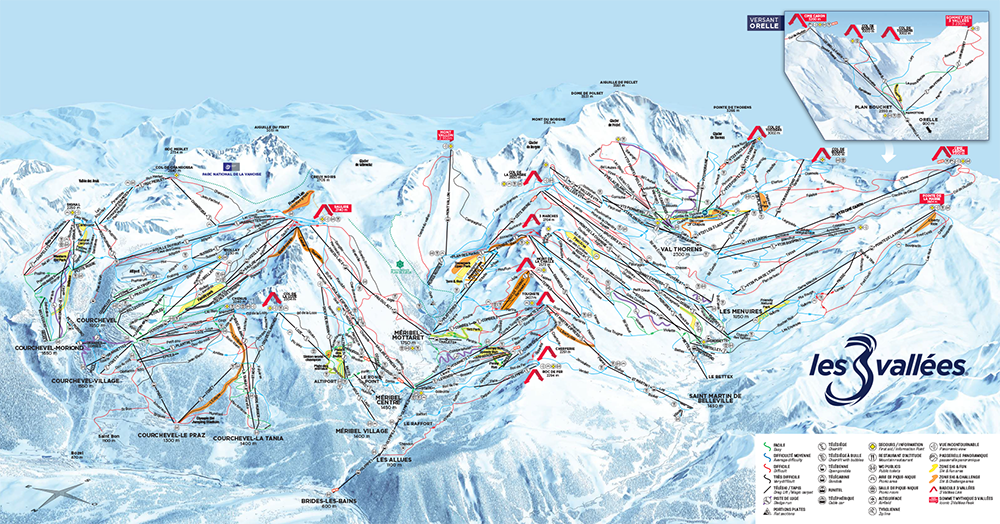 Les 3 Vallées’ expansive lift network is operated by four competing (and collaborative) lift companies that plan to invest a combined €200 million in lifts over the coming years.
“Most [U.S.] resorts are empty during the week and totally full during weekends,” says Lalanne-Clouté. “To me, that means the experience is bad because when you arrive, there’s a traffic jam on the highway, in the parking lot, on the slopes, and at the lift queue.”
It’s not that traffic isn’t an issue in Europe. But Lalanne-Clouté says the resorts do a better job of spreading it out somewhat evenly throughout the week by creating destination experiences that compel skiers to stay for more than a weekend.
Not to mention, there is a greater focus on walkable base villages and ski-in/ski-out properties—and pricing variation in lodging. “Visitors can find everything from affordable lodging and self-catered apartments to high-end luxury hotels, chalets, and premium services, all within the same connected ski area,” says Les 3 Vallées PR and communications manager Emie Charpentier. “That flexibility makes it easier for travelers to plan a trip that matches their budget while still accessing the full scale of the domain.”
Famous après ski. “We’re attracting people from all over Europe, and we guarantee a good experience during the course of a week” at Val Thorens, says Lalanne-Clouté. “Après ski is very famous here. A lot of our clients are young and want to party every night, which they can do at places like [Fahrenheit Seven], The 360, and La Folie Douce.”
At Les 3 Vallées, posters advertising various DJs, parties, and weekly events are plastered in hotel lobbies, elevators, and bathrooms in villages like Val Thorens. The ski area even hosts “themed” weeks, such as Belgian Week and Dutch Week, intended to draw visitors from specific countries during specific timeframes throughout the season. During these ticketed week-long events, famous DJs and artists from the featured country perform, daily parties are hosted at clubs, and other events and giveaways are promoted.
Boyne Resorts has experimented with bringing elements of that après experience stateside. One example is the Iglu concept—snow-built structures that function as social spaces with food and drinks. When the first Iglu opened at Sunday River, Maine, “we were not sure whether Mainers and Bay Staters would embrace it,” says Kircher. But they, apparently, took to the champagne bar, Jägermeister, and indoor/outdoor scene with verve.
Vail Resorts has also been learning from European partners, says Plack. Vail Mountain started hosting off-peak events, such as a sunrise pop-up DJ set atop a snowcat in the Back Bowls, accessible only by skiing or riding, on a random Friday morning in February.
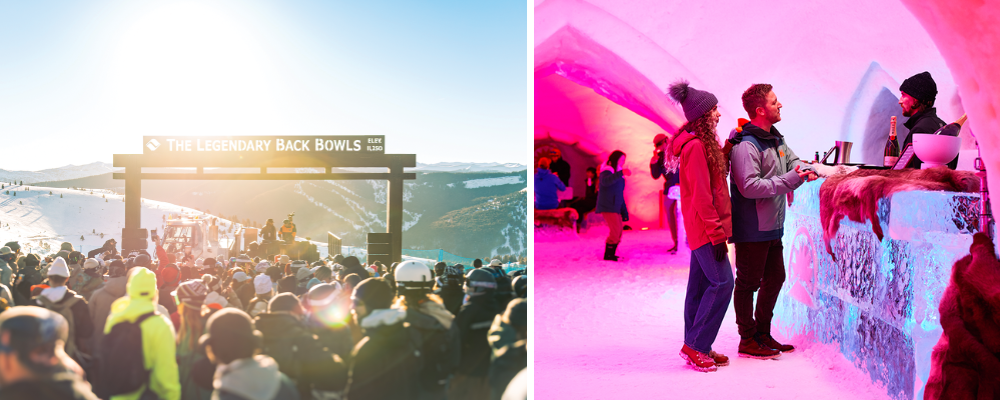 Left to right: Vail Mountain’s (Colo.) Back Bowls DJ pop-up is yet another Euro-inspired offering; Inside the Alps après-inspired Iglu at Boyne Resorts’ Sunday River, Maine.
Perceived Value
Multi-mountain passes have helped normalize the idea of skiing abroad. Epic, Ikon, and Indy all now include European destinations, allowing pass holders to use days overseas without purchasing a separate lift ticket. Epic and Ikon provide access to several of the Alps’ largest domains, including Les 3 Vallées, Verbier 4 Vallées, Zermatt Matterhorn, and Megève, while Indy Pass accesses dozens of independent resorts across Europe. All three have expanded their European offerings in the last two seasons.
Good for business. The trend has been a boon to pass holders and partner resorts. Partnering with European ski areas adds value to the multi-mountain passes, “allowing pass holders to ski all over the world for less,” says Lalanne-Clouté, while simultaneously promoting those European resorts in the U.S. market. “For us, this was our best advertising in the States,” he says.
For Vail Resorts, seeing guests take advantage of the European resorts that have been added to the Epic Pass is exciting. “It reinforces that those are the right decisions, and that those are the experiences some of our guests are looking for,” says Plack.
“The Epic Pass integration continues to fuel demand” at Les 3 Vallées, says Charpentier. The ski domain has seen exponential growth in Epic Pass customers for the last three seasons, with Epic Pass visitors increasing more than 50 percent in 2023-24, more than 22 percent in 2024-25, and another 50 percent in the first half of 2025-26, according to preliminary data.
Not a threat. Kristin Rust, vice president of communications for Ikon Pass proprietor Alterra Mountain Company, sees the uptick of pass holders heading to Europe as a net positive. “So much of the Ikon Pass is about aspiration. True skiers and snow hunters want to get different locations under their belts, so once they’ve [skied] the big resorts here, they head overseas,” she says. “But I’m not worried about U.S. ski areas losing business to the European market because it’s not an annual occurrence for most pass holders—they’re still going to go to their favorite resort here.”
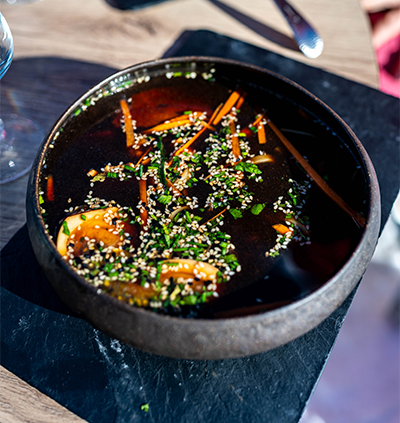 Delightful cuisine at Courchevel’s Le Dôme in Les 3 Vallées (Photo: Josh Laskin)Plack similarly notes that the Epic Pass offers European destinations for its segment of pass holders seeking unique travel opportunities, but there’s no evidence that U.S. ski areas are losing skiers to Europe.
Kircher suggests the appeal of the Alps often comes down to how multiple elements work together. When thinking about how to transpose the good ideas he sees in Europe to the U.S. market, “we are looking at the ‘and,’” he says. “You have to have great lifts and great experiences beyond the chairlift.”
Multi-mountain passes, Kircher agrees, have helped open the door for U.S. skiers and riders to visit bucket list European ski destinations. Once there, what they find—top-of-the-line lifts, quality food, and memorable experiences that extend beyond the slopes—reinforces the idea that the Alps offer good experiential value for dollars spent.
The Alps experience is partly a function of who has survived climate change impacts and market swings. The consumer often equates the European ski experience with high-alpine destinations, where the snow has remained reliable, such as Les 3 Vallées where 85 percent of the terrain is above 5,900 feet, according to Charpentier.
Many lower elevation ski areas in Europe, however, have been forced to shutter, driving a disproportionately larger share of the market to the famous high elevation destinations while the mom-and-pops with less reliable snowpack (and less capital to invest in snowmaking and other infrastructure) struggle to compete. “It’s a lift and snowmaking infrastructure arms race there, which we could see happening here, too,” observes Kircher.
For North American operators, then, the takeaway may be less about competing with Europe, and more about investing in elements that elevate the overall guest experience.