



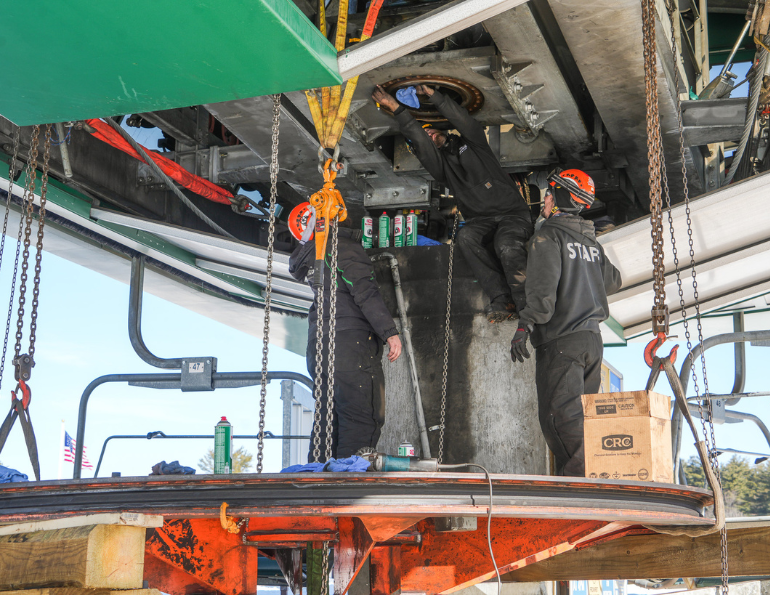
It was a Saturday afternoon during Christmas week, and Dave Moulton was giving a lift operator a lunch break at the top of Mount Snow’s Grand Summit Express. He was the director of mountain operations, but when J-1 staff are still in training and the mountain is short-handed, you do what needs to be done. After the GSE operator returned, Moulton walked over to the Bluebird Express to cover another lunch break. He was sitting with Chris Burke, the mechanic on coverage, when their brand-new six-pack, barely two years old, threw a fault.
AB rollback. The sensors that track cable direction registered backward movement.
“I’m going to reset and try again,” Moulton told Burke. They didn’t think much of it. He hit the start button. Immediately: fault.
Burke went upstairs to look. Within a minute, he was yelling down, “We’re gonna have to go to a rope evac.” The drive shaft had snapped clean off, ripping apart the gears inside. The gearbox was destroyed. The diesel backup was useless because everything runs through that gearbox. There was no way to spin the lift.
“Chris pointed through the window,” Moulton recalls, “and I could see the broken end of the shaft. That was the ‘oh shit’ moment.”
The uphill side was 95 percent full. Sixteen empty seats out of roughly 300. Saturday of Christmas week.
Moulton called the evacuation in about thirty seconds. “I called it so quickly, everybody was like, ‘What? The lift just went down and now he’s saying rope evac?” It was a stroke of luck that he happened to be standing right there. No waiting for a mechanic to relay information. He was at the drive, saw the failure, made the call. Ninety minutes later, every single person was safely off the lift.
That speed didn’t come from nowhere. Moulton had spent years running incident command drills on the deck of the resort’s Cuzzins Bar & Grill with his teams. “Here’s the situation. The lift is fully loaded, and then this happens. What are you gonna do?” he’d say to the gathered staff. The lesson was always the same: grab your checklist, stay focused, and don’t be the person running out to throw ropes. Be the one making sure nothing gets missed.
The lift was cleared. Then the real scramble began.
End-to-End Effort
The gearbox was manufactured by Kissling. Leitner-Poma had built the lift. Within hours, both companies were working the phones.
“The gearbox manufacturer actually made an error in the way they machined the shaft,” says Moulton. “They took responsibility.” They found a replacement in Germany, discovered the same defect in that one too, fixed it, and shipped it. Forty-eight hours later, the part cleared customs in New York and arrived at Mount Snow in Vermont.
Jeff Cousineau, from Leitner-Poma, and a Kissling gearbox specialist flew in. Dennis Bills, Mount Snow’s lift maintenance specialist with 45 years at the mountain and the kind of guy who would sleep on the floor of his office until the job was done, had everything disassembled and ready for them. Moulton had the resort’s food and beverage team bring hot coffee, chocolate chip cookies, and brownies. “Helped to keep them rolling,” he says. Fourteen hours later, the Bluebird Express was turning again.
Mount Snow’s staff worked right alongside the specialists and learned as they went. As challenging as the situation was, “It’s a great teaching moment,” Moulton says.
After the holiday week wrapped up, he brought the whole team together for lunch and recognition. Because in the middle of it, there’s no time to celebrate. You fix the lift and then you still have three more days of Christmas week to get through.
Those training sessions where Moulton threw impossible scenarios at his team? Turns out “brand new lift fails on the busiest day of the year” wasn’t impossible after all. Pay attention in training. Murphy’s Law loves a holiday week.
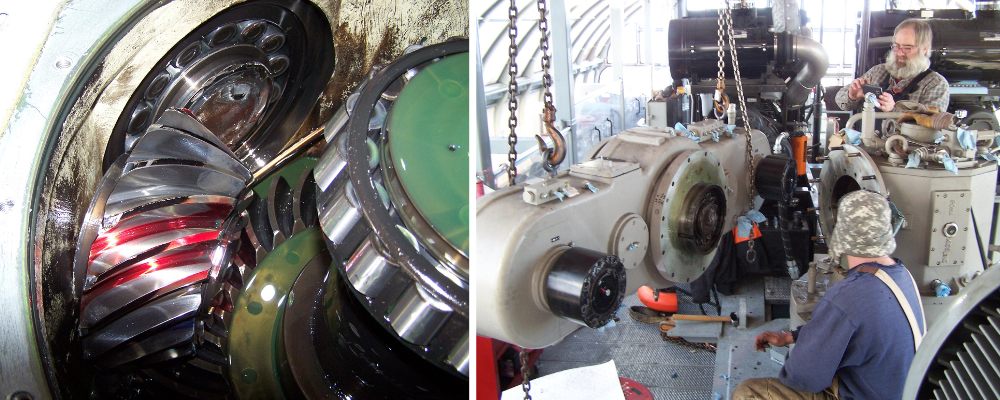 Mount Snow’s (Vt.) Hank Darlington and Poma’s Jeff Cousineau prepare the resort’s Bluebird Express for a replacement gearbox after a manufacturing defect saw the original drive shaft snap (left) during Christmas week.
When the Phone Rings
Elie Roy’s company, Royal Electric in Woodsville, N.H., is one of the outfits mountains call when they can’t solve a problem on their own. Ask Roy about unexpected failures after decades in the business and he doesn’t miss a beat: “At this point, they’re all expected.” The hours? “We’ve certainly seen some sunrises,” he says.
What happens when the parts don’t exist on a shelf? “We’ve had to search high and low. But almost always, when someone is desperate for a part and another resort has one, they are more than willing to help out. This says a lot for the industry.”
That collaboration between ski areas happens a lot. Andy Cornish, then the director of mountain operations at Catamount in Massachusetts and now general manager at Berkshire East, Mass., found that out around Christmas 2024 when three of his lifts went down within three days of each other during holiday week. The summit lift’s 350-horsepower electric motor was shot, and with the entire 2024-25 season stretching ahead of him, Cornish put a call out to the industry. Mount Snow answered. During Moulton’s tenure there, it had kept a spare motor in storage that fit the bill. Cornish had it installed within 48 hours and the lift back online. When Catamount’s motor was rebuilt, Cornish returned the spare.
“Nobody wants anyone to be down and out,” Moulton says. “It’s bad for the industry in general.”
Contractors like Roy get it, too. “There is no greater feeling,” he says, “than walking away from a turning lift with a smiling customer after finding the problem and fixing it.”
The Conductor’s Symphony
On Sunday, Feb. 16, 2025, during the busy Massachusetts vacation week at Gunstock Mountain Resort in Gilford, N.H., a lift operator on the Panorama express quad heard something wrong—an unusual sound from the terminal. The operator did exactly what annual training taught: reported it to lift maintenance immediately.
The team called last chair, ran the line off to unload seated passengers, and investigated. Planetary gearbox failure on Gunstock’s primary summit lift.
“I would be dishonest if I glossed this over,” says Robert Drake, Gunstock’s president and general manager. “It’s an ‘oh no’ moment when the issue is something this serious, and of course, that is immediately followed up with ‘how long?’”
The answer was not what anyone wanted to hear during one of the busiest weeks of the season.
One of the first calls went to field technician Donnie Martin at Doppelmayr, the lift’s manufacturer. Martin lives within driving distance and was on-site within hours. The original estimate for the replacement part was three weeks. However, Martin made a few phone calls and located a part in Utah. Then came the next setback: the part was so new it hadn’t completed initial testing, which added days to the timeline. When it was finally ready to ship, air freight fell through. Doppelmayr arranged a special dispatch with a private courier, sending two drivers to expedite transport from Salt Lake City.
Drake’s team didn’t sit around waiting. They knew the bullwheel would need to be dropped to replace the planetary and that it was due for a spring inspection. So they dropped it, pulled the bad planetary, got an inspector on-site, and prepped everything so the new part could be popped in as soon as it arrived. A setback became a win. One less shutdown over the summer.
“I like to say that, as a GM, we are like conductors of a symphony,” Drake says. Nine vendors and about ten people contributed, with Doppelmayr playing the leading role. Martin stayed through the entire repair. Inside the resort, lift maintenance director Pat McGonagle orchestrated the mechanical team. Robin Rowe managed guest inquiries and rainchecks. Bonnie MacPherson handled external communication. Every lead knew their part. A symphony in action.
Drake also made a decision that set the tone for the entire week: full transparency.
“So often our industry tends to mask what’s really happening, using phrases that leave our guests frustrated,” he says. Instead, Gunstock shared daily updates on its social media channels, including explanations of progress and photos of crews working. Being upfront protected the frontline employees who would absorb guests’ frustration face to face. Give people the full picture and they can make informed decisions about their trip. Offer rainchecks, and they’ll come back.
Once the gearbox arrived on Friday, the team worked until roughly midnight. They were back at it by 6 a.m. Saturday. Six days after that first unusual sound, the Panorama quad passed its final tests. The team celebrated by passing out freshly made chocolate chip cookies in the lift line.
“Guests cheered and our team stood with pride as we watched the first skiers load the chair to the summit,” Drake says. “I still hear to this day, one year later, about how awesome those chocolate chip cookies were.”
They liked the idea so much that Gunstock now hands out freshly made apple cider doughnuts every weekend, courtesy of a local farm. A tradition born from the worst week of the season.
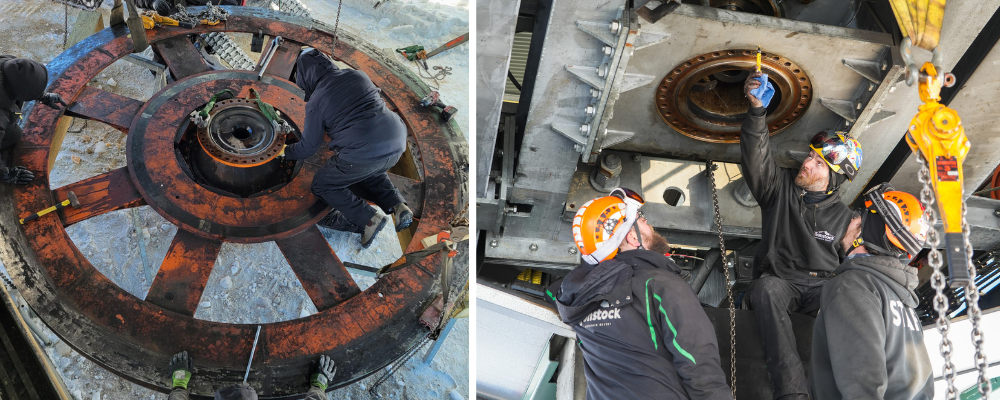 Gunstock, N.H., crew inspect the Panorama lift’s planetary gearbox after a vacation week lift failure. Left: the bullwheel is removed for repairs.
The Cross-Country Sprint
Most skiers think lift mechanics hibernate in the off-season. They don’t. At four-season resorts like Waterville Valley, N.H., the lifts never really stop. They just change passengers. Snow’s Mountain is a double chair that runs during the non-winter months, serving hikers and bikers and driving guest visits to the valley through spring, summer, and fall.
It was 3 p.m. on a Friday in early May 2025, and Waterville operations manager Marissa Preston was staring at her phone. A 1972 Ford 391 gas engine, the kind you’d find in old heavy-duty trucks and in the drive of the Snow’s Mountain lift, was ordered months ago from a shop in Spokane, Wash. Opening day was one week away. Two conferences were booked specifically for the lift experience.
The delivery truck wasn’t coming. “We missed the shipping window. It’ll have to wait until next week,” the shop told Preston.
But that wouldn’t do.
“I thrive in chaos,” Preston explains. “I am an absolute disaster of a human in the real world. Can’t find matching socks, forget appointments. But when shit hits the fan, my brain fires on all cylinders. Failure is never an option.” She pauses. “Want to see me panic? Ask me to file my taxes on time.”
She called snow surfaces manager Nick “Bacon” Blake. “Do you happen to have a snowmaker who might want to fly across the country tomorrow, pick up this motor, and drive it back as fast as possible?”
“I got you,” replied Blake. Two minutes. That’s all it took.
Barret Gareau had worked in nearly every department at Waterville. He was up for the adventure. But first, the motor had to get out of the shop before it closed for the weekend. Preston called her cousin Laura in Washington State. Laura and her friend Kathy battled Friday rush-hour traffic across Spokane, arrived right at closing, and loaded the motor into an SUV.
Saturday, Gareau flew west. By 10 p.m., he had the motor loaded in a rental truck and pointed east. For 49 hours, he drove across the country. Meanwhile, back in New Hampshire, lift maintenance prepped parts from the old motor, vehicle maintenance shop manager Jody Pieczarka stood ready to rebuild the carburetor, and the team sourced every component they’d need.
Tuesday, 8 p.m.: Gareau rolled into Waterville Valley. Wednesday through Friday: all-ops installation. Everything that could go wrong did. Incompatible old parts, delayed new parts, finicky antique motor tuning. But by Friday, the Snow’s Mountain lift was ready for summer.
Here’s the kicker. Preston had left on Monday for a strategic planning retreat while Gareau was still somewhere on I-90. She stepped out of meetings all day to coordinate with him and the team back at Waterville. On Tuesday evening, she pulled her boss, Tim Smith, aside after dinner.
“Boy, do I have a story for you.”
Tim’s instant reaction? “Hmmm, what are we going to do? Can we fly out there and grab it?”
She laughed. Only Tim would have the exact same idea. “Most bosses would have lectured me for making such drastic decisions without authorization. Not Tim. We’re empowered to problem-solve.”
Not one person on her team said, “That’s not my problem.”
The replacement motor had a good first season running the Snow’s Mountain lift thanks to these efforts. Proof that when a team refuses to accept “wait until next week,” impossible becomes Tuesday at 8 p.m.
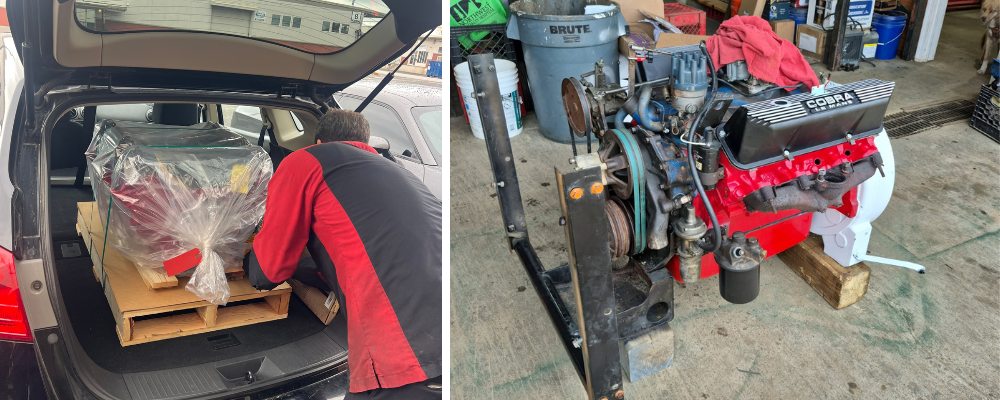 Damage control: With a bit of help, Waterville Valley, N.H., staff managed to pick up a replacement motor on a Friday evening in Spokane, Wash., load it into a rental truck on Saturday, and drive it back to the resort for installation by the following Friday.
It’s What We Do
These scrambles almost never make the news for the right reasons. Lift failures and evacuations get plenty of public attention because drama sells. What doesn’t trend on social media is the part that comes after: the parts airfreighted from Germany, the overnight fixes, the snowmaker who drove 49 hours across the country because someone asked and he said yes. The comeback story never goes viral. It just quietly results in a lift that reopens to transport skiers and riders who will never fully understand how fortunate they are to be going uphill that day.
But the people who were there know. And the next time they sit down for a scenario drill on a restaurant deck, or answer a call during off hours, or drive across I-90 with an antique motor in the back of a rental truck, they’ll know exactly why they do this work.
“All of us in the business just look at any area struggling with a lift issue and think, but for the grace of God, there go I,” says Moulton. “We feel for those in trouble and just want to get them out of trouble as fast as we can. We know the angst and stress it causes and don’t want to see others go through it.”
“We are the gatekeepers, the stewards of the mountain, the last line of defense when it comes to the safety of the humans who come to brave the rugged terrain,” says Preston. “If we don’t do our work, in the quiet of the twilight, at the breaking of the dawn, then we let down the people who come here to enjoy this escape into the wilderness. In the end, we are servants of the people, but most importantly, of the mountain.”