



As traveler expectations evolve— shaped by climate realities, new technologies, and the desire for deeper, more meaningful experiences—the summer season has become, globally, one of the most exciting playgrounds for innovation in mountain tourism.
We all know why summer matters—it helps diversify revenue, maximize lift and lodge assets, and support year‑round staffing for better retention. Here we explore what’s changing and what’s next, and look at how summer operations trends differ in various parts of the world.
This article draws on a panel from the 2025 SAM Summer Ops Camp in Whistler, British Columbia, featuring: Henrik Volpert, CEO of Oberstdorf Kleinwalsertal Mountains in Germany and Austria; Janelle Visser, managing editor of Arival Travel; and Justin Downes, president of Beijing’s Axis Leisure Management and operator of Hanazono Resort in Niseko, Japan.
A Shift in Traveler Preferences
Arival tracks all kinds of traveler trends through annual surveys to figure out where people are going, what they are spending money on, what they are not spending money on, how they are booking, and the answers to a variety of other questions.
Over the last few years, said Visser, Arival’s global research shows a clear move from destination-based travel to passion-based travel. “What I mean by that is people used to say, ‘I want to go here; I’m going to book my flights, and then I’m going to figure out what to do when I get there.’ And now, the younger generations are saying, ‘I really love doing this thing. Where can I do it?’”
Millennial and Gen Z travelers, particularly affluent younger travelers, are choosing the activity or theme they love and then booking a trip to the place that delivers it. That reframes the hierarchy of travel, with flights, accommodation, and transport playing supporting roles, while experiences like tours, activities, and attractions are the lead actors.
For mountain destinations, this shift represents a chance to reach travelers earlier in their decision-making process—before they’ve chosen a specific place—by positioning themselves around the passions that drive travel choices, like biking, hiking, or wellness.
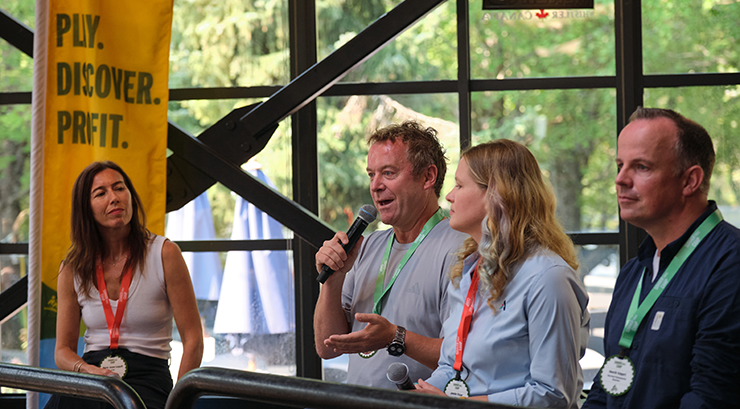 Justin Downes, with fellow panelists Janelle Visser and Henrik Volpert and moderator MJ Legault (left), addresses travel trends in China and Japan at the 2025 SAM Summer Ops Camp.
Regional Lenses
Asia: Wellness, Learning, and FIT
Downes, who has been instrumental in the planning, development, and operation of more than 30 mountain resorts and indoor ski facilities in Asia, has seen the trend evidenced in both China and Japan.
In China, a post‑Covid push toward health, sport, and time off is accelerating participation in outdoor activities domestically and abroad. The growth appears part reaction to stringent pandemic lockdowns and part government initiative, with the country’s burgeoning outdoor sports sector earmarked as a new economic growth driver to be supported with planning, construction, and incentives. “People are engaging with not just sport and outdoor lifestyle, but they’re being incentivized to get into sport training, to have a better diet, to stop smoking, drink less, tone their bodies, and these types of things,” said Downes.
As a result, he said, “Thirty years ago, biking in China was a form of transportation. Now, it’s a status symbol; everybody wants to get into it. Yoga and culinary tours are also very powerful in China.
“I think most people actually are choosing their destinations in Asia now based on what type of culinary experiences they can have,” he added. Arival data show that food is among the fastest growing travel-drivers globally.
Another shift: while in the past people in China “mostly went on group tours,” said Downes, FIT (free independent travel) now leads the tourism market, with more travelers curating their own multi‑stop, multi‑interest itineraries. “People are really looking for their own experiences—based on sport or another interest,” he said.
In Japan, “everything has a wellness/onsen, hiking, cultural, and culinary component,” Downes said, with tourism programming evolving from what Downes frames as a cultural preoccupation with personal growth. For example, Hanazono’s guided winter backcountry offerings have inspired summer off‑piste hiking programs that pair gym conditioning and nutrition coaching with multi‑day, overnight treks. Activities such as agritourism (think fruit‑picking) and photography classes also add layers to the Niseko region’s outdoor recreation offerings.
“Asian culture is very interested in learning about how to improve and how to look after oneself,” Downes said. “These (e.g., camping, nutrition, photography) aren’t things people learn in school, so now they’re looking to get into an experience and want to do it at the highest level.”
The demand for learning experiences, said Downes, means that an Asian family might seek out a destination that offers a variety of activities with an educational component, be it ecology, animal husbandry, art, language, cultural heritage, skill development, or foodways.
Europe: Food, Family, and Authenticity
At European mountain destinations, Covid was also an outdoor recreation accelerator. “Tourism is becoming even more important now, and we consider ourselves not as a ski resort but as an all-year operator,” said Volpert.
Climate change is causing a shift as well, driving more tourists away from the sunny beaches of southern Europe into the mountains for a cooler summer vacation. “In Europe, if you look at the media, they are always saying nobody wants to go to Italy to the beaches anymore or to Spain because it’s far too hot, especially in the summer season,” said Volpert. “So, people are really looking for a joyful day in the mountains.”
Oberstdorf Kleinwalsertal (OK) Mountains—a group of seven ski areas on the border of Germany and Austria—has embraced the four-season potential of its ski areas, with lifts turning year-round and F&B as a critical piece of the guest experience.
“In August, Oberstdorf is fully booked, just as it would be in January,” said Volpert, adding that the group also sees the potential for growth in the shoulder season. “Whether it is April, May, September or October, families come out and visit us.”
They are looking for “wellbeing,” he added. More than 95 percent of OK Mountains’ guests are destination visitors from within Germany, he said. For them, “it’s not about being a sports fanatic, it’s not about working out, it’s about spending a relaxed day on the mountain. F&B is incredibly important to this guest, and that means traditional, local, homemade food.”
To that end, a relaxed, joyful day on the mountain in summer might look like a two‑hour hike, then a farmhouse beer and cheese stop at an alpine hut, and a stroll to the next refuge, said Volpert.
Of course, it’s not all about food. OK Mountains’ has also built its activity infrastructure around the same relaxed-in-nature ethos that drives its visitors, he said. “So, we don’t want to see, for instance, any plastic up there on the mountain.”
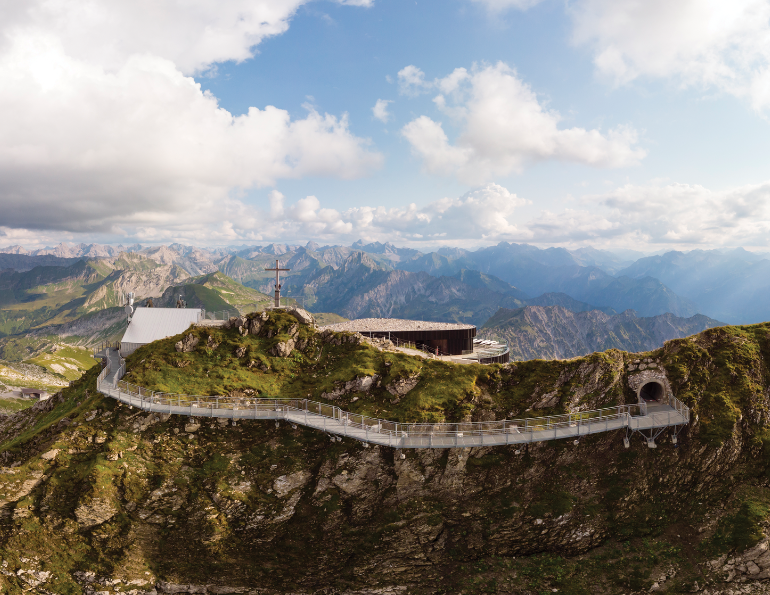
Simple products, big payoff. Volpert highlighted two seemingly basic offerings at OK Mountains that outperform their simplicity. The first is Nordwandsteig, a free, 100-meter steel catwalk at the summit of Nebelhorn, adjacent to a recently reconstructed restaurant, that allows folks to take in the views. Part of what makes it successful, said Volpert, is that it provides easy access to the high alpine. “You can have the look and feel of an alpine pioneer, more or less,” without the need for the skill, he said.
The other is a marble run, or ball track, set up along a 2 km hiking trail, with five 100 m segments down which kids can roll wooden marbles as the family walks the trail. OK Mountains added the product 10 years ago, and Volpert said the investment has paid off multifold. “If you want a family with two or three kids to hike for an hour or two, you need a great product for the kids,” he explained.
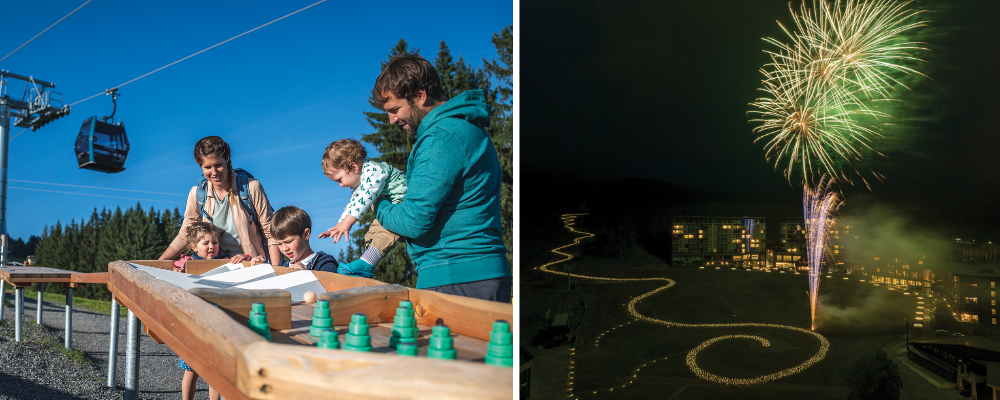 Left to right: Families at OK Mountains in Germany/Austria can enjoy an outdoor walk while the kids are entertained by the ball-track adventure along the trail; The Prismatic Springs mountain lights art walk at Hanazono is a unique “soft experience” that draws thousands of visitors to the resort.
The Trends
There are some common themes across the trends Downes and Volpert identified in their respective audiences, and these are echoed in Arival’s data, which track popular “experience” categories.
According to a survey of 7,500 travelers, the fastest growing categories in the U.S. and globally are:
- Wellness (e.g., coaching, hot springs, Nordic spas)
- Culinary (e.g., street‑food walks, distillery tours, “food‑plus‑activity” pairings)
- Events (e.g., concerts, festivals, sporting events)
- Experiences with locals / people with local knowledge (e.g., ski with a local Olympian, hike with a local naturalist)
- Thematic tours (e.g., photography tours, heritage walks, ghost tours, horseback riding)
Elaborating on the trends, Visser said that experiences like event- or wellness-driven travel can bring folks to a location, and they’ll seek other tourism activities while there. Niche offerings like ghost and vampire tours, for example, are growing in popularity. Additionally, she said, “Research shows that people want to do the things that they love doing, but they also want to eat local things, they want to eat authentic things.”
Think Regionally, Act Collaboratively
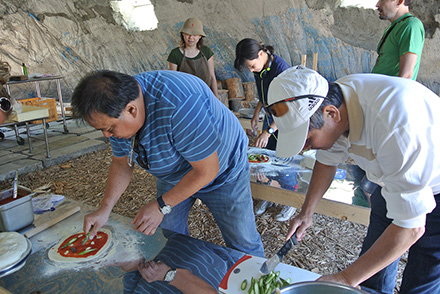 A farm-to-table pizza-making activity near Hanazono Resort in Japan capitalizes on the growing interest in culinary travel experiences.Capitalizing on these trends means recognizing where your ski area fits in a larger travel ecosystem. For example, said Downes, when it comes to capturing international visitors from the wider Asian market, the first objective is to get them to choose Japan, then Niseko, and then the resort, Hanazono.
“Right now, our average length of stay is only around 2.2 nights,” he said. “There’s not enough really to keep them longer.” So, it’s important not to fence customers. “It’s not about trying to protect our own turf and keep people within our walls,” said Downes. Instead, the goal is to position Hanazono Resort as a hub for a two‑to‑three‑hour activity radius (surfing, sea kayaking, fishing, 30 golf courses) so they stay longer.
Soft experiences—place-based activities that create memories, rather than offerings that can be replicated elsewhere—support that effort. A nighttime “mountain lights” art walk called Prismatic Springs attracted 100,000 visitors to Hanazono Resort over four years—a “very big draw” for a resort that doesn’t do many summertime visits to start with, said Downes. “We see it as a kind of catalyst, or a key differentiator, that brings people to the area,” he said.
Partnerships can also be advantageous to that end. Visser points to Sydney, Australia, as a blueprint. There, museums, galleries, and cultural sites, such as the Sydney Opera House, have packaged VIP/back‑of‑house experiences under a shared banner. The offering helps differentiate the activities among others in the busy city, said Visser, who pointed to the rising interest in unique, VIP experiences that might cost a little more, “but it’s something that not everyone can do.”
Community partnerships are integral to the business model in the Alps, where mountain companies typically operate lifts and manage snow surfaces, while lodging and F&B are separately owned. “As a CEO,” said Volpert, “I consider myself more as an ambassador or diplomat trying to bring all these different stakeholders together and align them behind one strategy, one shared vision, and one goal.”
While that has its challenges, it’s yielded some unique products as well. Among them is a sort of “summer season pass” that hotel and guest house owners can acquire for each of their available beds. “So, every time a guest is staying with your hotel, he or she can use our cable cars and our products more or less for free,” said Volpert. Of 16,000 available beds, more the 14,000 are enrolled in the pass program, which makes up almost half of OK Mountains’ total summer revenue.
Events are another tourism driver on which ski areas can capitalize through strategic partnerships, said Downes. Events can put destinations on the map and create tradition and repeat visitation. “But these things cost money; somebody’s got to underwrite these things,” he added. Collaborating with the community to help support events and getting funding through government and sponsorships are keys to success.
The New Travel Agents
Another way to get on the map: social media.
Social searching. Arival research shows that social media is the prevalent source for guest inspiration, research, and even booking when it comes to certain cohorts. Younger Millennials and Gen Z are travel planning in TikTok and Instagram, and staying in the app through the booking process if they can (TikTok, for example, is partnered with Asia-based OTA Klook to allow for in-app travel bookings.).
When asked what formats or what content type works best, the panelists agreed it’s short form videos. And KOLs (key opinion leaders) in Asia—that is, social media influencers who are seen as an expert or authority—are key bookings drivers for Hanazono, said Downes.
AI impacts. For the folks still relying on Google as their primary travel research platform (older Millennials and up), the AI overview feature is changing how people search. On the one hand, it is tanking direct website traffic. But agentic AI—AI systems that can plan, reason, and act independently to complete complex goals with minimal human prompting—may also represent an opportunity to create more curated, personalized travel experiences, said Volpert.
What are folks looking for in their travel research? In addition to wellness, culinary experiences and the like, they also want to find destination dupes, said Visser. That is, places that offer similar experiences as high-profile destinations with a fraction of the crowds at a fraction of the cost (think: the Julian Alps for the Dolomites, or Bodrum for St. Tropez).
“That could be a great opportunity for a lesser-known resort to step into that space and say, ‘We have mountains and all mountain things. So, if you want a little more off-the-beaten-track experience, think about us,’” said Visser.
Takeaways
The lessons from around the globe are clear: lean into passion‑led products; authentic and/or elevated F&B has game changing potential; soft infrastructure such as trails, viewpoints, catwalks, art walks and family play features deliver outsized returns; strong regional ecosystems improve individual business performance; and when it comes to travel planning, it pays to meet guests where they are at.
Summer adventures aren’t just about filling a season; they’re about rethinking what travel can be. It’s about creating experiences that are innovative, connected to place, and meaningful for both guests and communities. If we get that right, the best trends won’t just be the ones we follow, they’ll be the ones we start.
Visit our Summer Ops Mountain Department for more summer ops insights.