




A handful of intriguing ownership models have popped up in the past year, portending a potential return to the starry-eyed past, when resort owners hung cable rather than hosting analyst calls. The new models include a group of high-net-worth second-home owners buying Killington; the potentially heroic but problematic municipal purchase of Eldora Mountain Resort; and the promising three-class ownership model formed by Indy Pass owner Eric Mogensen at Black Mountain, N.H.; alongside revival efforts at legacy independents like Burke Mountain, Vt., and Kissing Bridge, N.Y.
It’s difficult to call this a trend away from conglomeration when Vail Resorts (VR) still owns 42 ski areas and Alterra Mountain Co. counts 19 plus some 50 more partner resorts on its Ikon Pass. But conglomerate growth has slowed or even stopped in North America, Epic Pass growth has peaked, and it’s an exciting (if challenging) time to be an indy.
Backstory: How We Got Here
In 2023, John Cumming’s Powdr Corp. decided to at least partially cash out of the ski resort business after a largely successful and passionate 30-year run. Powdr ultimately packaged five resorts, led by Killington/Pico, Vt., and including Eldora, Colo., Mt. Bachelor, Ore., and British Columbia’s SilverStar. A deal was struck with Alterra, which would have given it more owned mountains in its arms race with VR.
Few people would ever know the significance of this transaction, because it fell apart in due diligence. So it was on to Plan B for Powdr: Selling the resorts individually—and in doing so, creating intriguing ownership models.
Gaining Independence
Cumming might have opened a bidding war for Killington, the premier resort in the East, but instead he recruited the .01 percenters. Cumming called Phill Gross, the co-founder of Adage Capital Management and a Killington second-home owner who had learned to ski there in 1985. Gross dialed his friend Michael Ferri, another Killington second-home owner and the owner of the Valvoline Instant Oil Change and Mr. Sparkle Car Wash franchises. Both men have skied around the world and own property at the Yellowstone Club, but their love of Killington started it all. “We have to do this,” said Ferri, who first skied there in 1970 and has three sons who attended the Killington Mountain School.
Killington’s Win-Win: Not Duplicable?
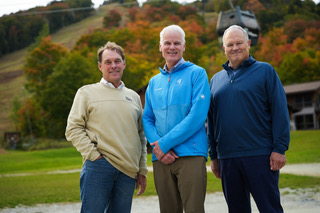 New Killington / Pico owners Phill Gross (left) and Michael Ferri (right) with resort chief Mike Solimano.The two became managing partners of the fittingly named Killington Independence Group, whose first charge was to ensure that the resort did not go to unlimited access on the Ikon Pass. They recruited other investors among the affluent second-home owners and soon found a dozen takers. The rules were simple: We are not owner-managers but caretakers, don’t expect liquidity or big returns for 10 years, keep a low profile, and don’t expect any perks. Those who wanted a quick buck or a traditional investment quickly dropped out.
The new owners had complete confidence in the stewardship of president and CEO Mike Solimano and his team, and they offered life-changing equity to a dozen top managers. This wasn’t a turnaround; Killington was already profitable. Otherwise, “I don’t think we would have done it,” Ferri says.
Also critical: They are bullish on the eventual completion of Killington’s $3 billion base village and the 25-year master plan of Toronto-based developer Great Gulf, which along with Powdr is also a partner in the new ownership group.
Solimano started in the Killington finance department 21 years ago, under the highly leveraged American Skiing Company. In his first week, ASC couldn’t meet payroll, and Solimano handled the layoffs. In the ensuing years, he survived and then thrived along with the resort’s fortunes. Solimano praised Powdr’s ownership and investments, but he admits there were years when the resort could barely buy a snowcat.
This is a new world, and Killington’s owners have committed $60 million in capital spending its first two seasons. They also strike the perfect balance of oversight: “They are interested,” Solimano says, “but not too interested.”
The scale of the Killington ownership can’t be copied in the rest of the ski world, but perhaps the basics can. Local control and sufficient capital are key elements for any successful model.
Eldora: Gnat Swallows Giraffe?
Eldora’s ownership fate, which could be decided by the time you read this, is a compelling approach but also a roll of the dice.
The quest of Nederland, Colo., to buy Powdr’s Eldora is well worth watching (for more, see SAM’s online special reports). Nederland is a tiny town 20 miles above Boulder, with a $3.2 million budget, 25 employees, no police department, and a checkered history best defined by a reluctance to change. Now, it has somehow acquired the superpowers (and a funding tool: municipal revenue bonds) to guide Eldora to four-season success. The town even hopes to leverage the resource to address its own complex issues of employee housing, transportation and childcare.
As SAM went to press, Nederland was planning to sell high-interest, high-risk municipal revenue bonds, paid off by resort revenues, not taxpayers. The junk bonds would cover the $115-$120 million purchase, plus, presumably, a $10 million “rainy day” fund and $2 million annually for maintenance. Once the fluctuating bonds are paid back, the town wants to use resort revenue to, among other things, repair sidewalks down in Nederland.
If this sounds like a big gamble, it is. Because of its self-imposed “silent period” during the underwriting process, Nederland has been unable to answer the biggest questions. How is a struggling, indebted town going to fund capital improvements to keep abreast in the hyper-competitive Colorado Front Range market? Can it erect the guardrails to stay out of daily ski area ops? What happens when the next mayor hates skiing? And: Will Nederland set a sterling example for municipal rather than corporate ownership of ski areas … or an extremely poor precedent?
“A few folks have said we’re crazy to do this,” says Nederland Mayor Bill Giblin. “I say we’d be crazy not to.”
The Revivalists
Killington and Eldora are profitable enterprises. Elsewhere, acquisition targets are often resorts on the brink, requiring management team overhauls and new ways of doing business. These start with an emphasis on snowmaking upgrades and fixing aging lifts, reconnecting with the community and customers (online and in person), and a pledge to always listen and spend money to get better.
Black Mountain: A Practical Model?
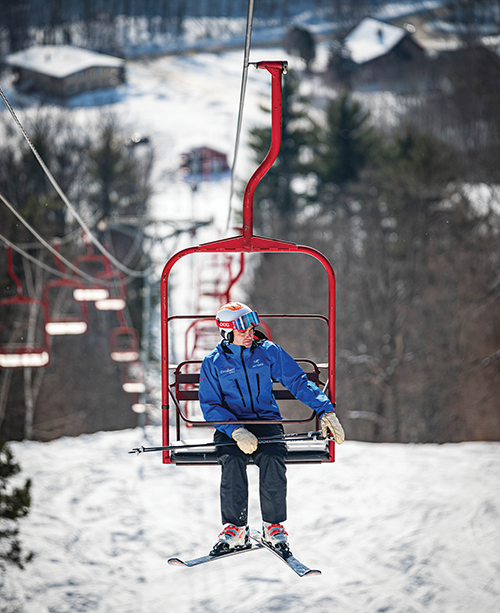 At Black Mountain (above), interim owner Erik Mogensen is crafting a three-tier ownership model. Black Mountain, N.H., is a prime example. Indy Pass and Entabeni Systems owner Erik Mogensen stepped in with his time and about $7.5 million to save the 90-year-old ski area from extinction, starting with an operating agreement for 2023-24 and then the acquisition of Black in October 2024. A former ski instructor who proudly admits he was fired by Vail Resorts, Alterra, and Powdr (“I’m not a good employee”), Mogensen is serving as the bridge to a new future. He is now the owner, president, and GM of this small ski area, but on an “interim” basis only.
Building the future. In his inaugural season as owner of Black, Mogensen doubled snowmaking output and spun the lifts until May 3, recording 36,000 skier visits for its Thursday-to-Monday operations. This past summer, the rebuild shifted into high gear. This included a rebuilt lodge, a 30-percent parking lot expansion, 28,000 feet of new snowmaking pipe, and 200 more snow guns. The efforts culminated in Black being the first New Hampshire ski area to open this season—albeit not for daily operations—offering limited terrain to season pass holders on Nov. 15.
Mogensen admits that he might have gone overboard in his quest to show that Black “is back and better than ever.” He smiles as he says, “The problem with taking things apart is you’ve got to put them back together.” Perhaps, but his hands-on approach gave Mogensen invaluable experience on the daily ops frontlines, in capital spending, and in crafting a sustainable P&L and ownership model.
Three tiers of ownership. After 18 months of experience and research—and a big assist from his Colorado-based Entabeni staff, some of whom slept in their high-tech camper vans in the Black Mountain parking lot for this special project—Mogensen unveiled his new planned ownership model in early November.
When the transition is completed in the spring, Black will offer three classes of ownership. The 15 Class A members will invest $250,000 each; 100 supporters will join in with Class B shares at $25,000; and 2,000 Class C $5,000 shares will be sold (the Class C is similar to the co-op model of Mad River Glen, Vt.). All 15 Class A investors will get a seat on the 21-member board of trustees; there will be four trustees from Class B, and two from Class C.
The higher-priced shares are almost fully subscribed, Mogensen says, and he anticipates selling out all three classes quickly. A looming issue: Can a 21-member board make the dynamic decisions necessary to compete?
Math-inclined readers will note that the shares should raise $16.25 million. The extra cash above his initial $7.5 million investment will fuel capital improvements needed to keep Black competitive and sustainable into the future—an “endowment,” as Mogensen terms it.
Challenges and opportunities. Mogensen knows the odds are stacked against the little guys, from buying insurance to acquiring groomers and lifts designed (and priced) for the Stowes and Steamboats of the world. Mogensen believes that in the next decade or two several dozen of the nation’s small ski areas will face similar threats to those that nearly shuttered Black, so finding the right ownership model is critical. Developing an ownership model that can apply to other areas has been Mogensen’s goal at Black, and his model is scalable without losing local input.
Burke Mountain: New Money and Managers
In Vermont’s Northeast Kingdom, Burke Mountain is a solid gold pipeline to the U.S. Ski Team and the Olympics, but it’s usually been a DNF on the bottom line. Its “new-old” owners spent $11.5 million to buy the resort out of receivership and have pledged to spend $30 million in capital improvements.
For its first season, Burke doubled its snowmaking, joined the Indy Pass (the extra 5-15 percent of business it brings to small- and medium-sized operations can make the difference between a good and marginal season), and restored its old bear logo. It also hired a Vail Resorts lodging veteran to run its signature hotel.
The liberator is Bear Den Partners LLC, a coalition of the Burke Mountain Academy and the Ken Graham family (Graham co-founded and chairs Graham Inverness, the Philadelphia-based private investment firm, and has long ties to the academy and the ski area, including a brief ownership in the early 2000s). An ownership share and the management oversight went to Jon Schaefer and his family, owners of Berkshire East and Catamount in Massachusetts. Schaefer hired veteran Tom Day, who helped steer Waterville Valley, N.H., through four owners and revived county-owned Gunstock, N.H., to serve as interim GM; in November, longtime Schaefer colleague Gabe Porter-Henry was named as GM.
The new game plan has all the basic components for a turnaround: better data, better systems, better on-snow product, better (and actual) investments. When the racers who matriculated at Burke climb into the starting gate at the 2026 Milan Cortina Olympics, led by Mikaela Shiffrin (class of 2014), any viewer who Googles Burke will read about an ascending resort that’s less than a three-hour drive from Boston or Montreal, a market with a combined population of 8.6 million.
Kissing Bridge: Tech Guru Leads Revival
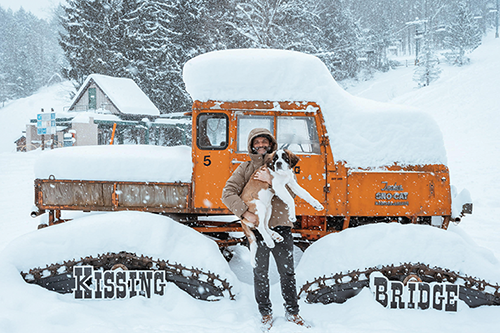 After a career in tech, Kissing Bridge, N.Y., owner Rhett McNulty has embraced his new venture.Outside Buffalo, West Coast surfer and ocean-lover Rhett McNulty is settling into his new role as the owner-manager-savior of the once-derelict Kissing Bridge (KB). The bearded forty-something entrepreneur already spends many nights sleeping on a cot in his office. That’s a far cry from a tech career that has taken him around the world, often to big mountains.
Investment and technology. His approach, like that of the other revivalists, includes investment and technology. For his inaugural 2024-25 season, McNulty cut season pass prices and more than tripled the open terrain, deploying 45 new stick guns (more snowmaking and automation are on the way for this winter). He shredded the old paper lift ticket system in a painful but necessary mid-season conversion to SnowCloud resort management software. McNulty’s efforts were applauded, and he quickly became known as the SoCal savior.
McNulty, who grew up in Santa Monica, Calif., skiing (then snowboarding) 50 days a year, arrived with plenty of cash. He helped found Shopping.com, which sold for $220 million, and then Shopit.com, which became the largest e-commerce app on Facebook. He doesn’t consider his $1.06 million purchase of KB to be pocket change, though, partly because he’ll need a lot more capital to make things work. McNulty is socially conscious with a philanthropic bent, but he’s not in this to lose money. He wants KB to be successful and sustainable.
The value of connection. Why is he here? McNulty doesn’t have a simple answer. If he did… it would be the Buffalo Bills, or more specifically their dedicated hyper-local fan base. It’s that local connection McNulty sought and is seeking to rebuild at KB with both its guests and staff. During a Zoom call from his office, for example, he fields questions from a walk-in visitor, a Buffalo-area dump truck driver looking for seasonal winter work. He eventually funnels the driver into the hiring process. KB has increased its winter staff from 200 at acquisition to 300 this winter.
McNulty has zeroed in on rebuilding KB’s customer base. At the extremes, he’s got the loyalists who will never leave, and then the ones who have gone away and will never come back. In between are the frustrated customers who need to be won back with a better experience. He wants to develop KB as a four-season resort, with an emphasis on wellness. Will he finish the challenge and then hire someone to keep it on track, or perhaps create a new ownership model that values local input?
Right now, there is only one regret: That he didn’t produce a reality show covering his first season at Kissing Bridge. Welcome to the small ski area world, Rhett.
What It All Means
There is not enough evidence on “new ownership models” to signify a trend, yet something is in the air that gives salve to those who feel that conglomeration has gone too far, or at least far enough. The benefits of pre-commitment ushered in by the Epic and Ikon passes led to the most successful transformation in modern skiing, a true renaissance. Vail Resorts and Alterra continue to dominate the ski resort business.
Independently healthy. But public opinion is strongly on the indy side. In an ironic yet understandable twist, the dominant ascent of corporate skiing has unleashed a growing appreciation for the independents, a groundswell seen among customers, communities, and high-net-worth individuals.
You can’t just be fiercely independent, though: These ski areas also must be smart, tough, and nimble, often against great odds, and find the money to continuously reinvest.
As Vail Resorts and Alterra go, so goes the ski area business. But new skiers aren’t going direct to Vail’s Back Bowls, or to sample the six new chairlifts installed over the summer at Alterra’s Deer Valley. They need to start at Eldora or Black or Kissing Bridge.
A $350 window lift ticket does not recruit diverse new guests. Creating new skiers is tedious work—and so is building the communities that are the backbone of the sport. They don’t show up quickly on the balance sheet.
Someone has to invent new ownership models for the Black Mountains of the world, and field the Kissing Bridge job application from the Buffalo dump-truck driver. That is what small- and medium-sized ski areas do best, and their improving fate will determine the future health of the sport, business, and overall industry.
Visit our Ownership timeline online to explore nearly 40 years of ski area transactions here.
Andy Bigford is the former editor-in-chief of SKI and has chronicled the resort business since 1982. He collaborated on and edited the two “Ski Inc.” books written by Chris Diamond, who died in 2023. At Diamond’s urging, he is working on a third book covering the resort business… maybe Ski Inc. 2030? He can be reached at andybigford@gmail.com.