



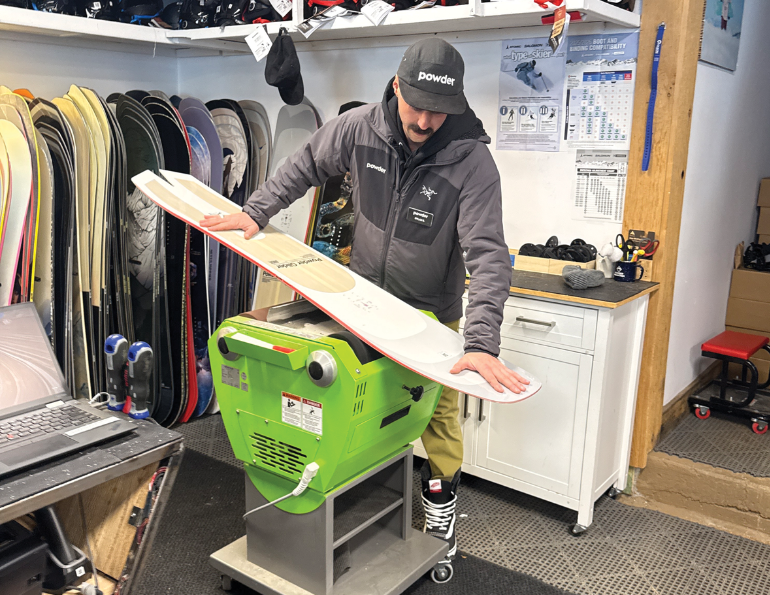
Rental shops process a lot of information. Data on rental customers, usage data on gear, pre-season and in-season binding test documentation, staff training, inventory management... the list goes on. To keep track of it all and make sure all necessary work is being done correctly, ski areas increasingly are relying on software.
Historically, rental shops have been run with lots of manual processes, and lots of manual documentation on paper, which can get lost or damaged. “It’s a pretty worrisome way to track something as important as a ski’s safety,” says Powder Mountain senior retail and rental manager Dylan Egli. “So, we knew that we just had to get out of doing things so manually.”
The importance of being earnest. It’s not just operators who see the need for greater control of data. Liability risk in rental operations is significant, which is why ski industry insurers stress the importance of consistent training for rental shop staff, proper documentation of all training and work, and adherence to standards to mitigate that risk.
SAM spoke with three rental operators and other experts to explore how resorts are transitioning to digital systems for a variety of purposes, from registering customers and training staff to binding testing and record-keeping. While no two rental shops are alike, and all have their own M.O., there’s still a lot to be learned from exploring how other operators operate. And there are some common challenges.
“We’re always in that constant battle of getting people through the process as quickly as possible while also making sure all our T’s are crossed and all our I’s are dotted,” says Egli. “Yes, we’ve been able to get guests out with a great fitting boot and a correctly set binding in under 20 minutes. But we’ve still got to make sure that we’ve recorded it correctly. We need to get our staff to understand the back side of rentals, where we have to do a lot of testing and a lot of maintenance.”
Guest and Gear Data
Powder Mountain: High Tech Tracking
Powder Mountain’s rental operation inventories 1,067 rental units, including fleet and performance tiers, across three locations. The resort recently switched to Axess point-of-sale and inventory management software. Egli has adapted the software to the rental department’s needs, a task for which he is well suited. Egli is new to rental management, but he’s been working at ski areas for a decade or more, starting when he was 14 at Ski Big Bear, Pa., including as a rental tech. He also has experience in software sales with ADP.
Software upgrade. With that background, the transition over the past year from manual paper records to digital logs has been smooth. “I’m using a few different things to track data and test results and manage the fleet effectively,” he says. “First and foremost, we’re on the Axess rental system. That’s been great so far. And we’re using their inventory management system, Clics, on the backside of that to manage our whole fleet.
“We get access to user information about what specific people are renting specific skis, and then also just at a brass-tacks level, how much that equipment’s going out. So then we can effectively test and manage that fleet and cycle things out as they get to the end of their life.”
Data management. For every item in the fleet, Clics contains its identifiers, status (available, rented, retired), and usage metrics. Binding testing, which is part of every binding manufacturer’s indemnification program, is also handled digitally. Powder employs the Wintersteiger Safetronic test machine (as do the two other shops we spoke with), which can export the test data to the Clics system. Although, Egli has found it more effective to manage that data through a shared Google Sheets maintenance log. “The spreadsheet allows smoother communication between myself and the tuning team, and gives us a custom, at-a-glance format that better fits how we operate day-to-day,” he says.
The log includes how many days the equipment has been rented, when it was last waxed and tuned, and when it was tested along with the test results. “We know then at least at a quick glance how our fleet’s maintenance is overall from a high-level perspective,” he adds.
Egli notes that for the performance fleet, this information is useful when gear is sold at the end of the season; he can prepare a ski version of a Carfax report for potential buyers, which helps set a price both the resort and customer are comfortable with.
Massanutten Resort
Massanutten, Va., stocks nearly 2,000 skis and 1,000 snowboards, using Wintersteiger’s Easyrent software for overall department management, along with Inntopia’s e-commerce/online booking software for advance reservations.
Adelia Valadez is the relatively new rental manager at Massanutten, but like Egli, she’s been working at ski areas since she was a teenager, starting at age 16, and in rentals for seven years. Plus, she has experience with using statistical tools and a degree in user interface design; all this informs her ideas about how to manage the department.
Valadez is very happy with Easyrent. Aside from recording guest registration information, the software enables automatic tracking of usage, maintenance, and testing. It even helps select gear for testing. The software is integrated with Wintersteiger’s Safetronic binding tester for inventory and testing management; it records test results and links these to technician IDs.
Integration issues, solutions. The one sticky wicket is marrying the Inntopia booking software with the Easyrent system; the two don’t talk to one another. In the past, that led to some issues with matching online reservations with data collected in the rental shop. Further, incorrectly typed guest data, language barriers (Massanutten relies on a lot of J-1 staff, and many guests are not native English speakers, either), and similar or identical names were creating issues in the shop. As a result, at one point, nearly 20 percent of guests were not actually paying for their gear.
To correct that, the shop instituted a customer barcode, which follows each guest through the rental process and more accurately stores key data. The no-payment rate has dropped to just 3 percent. The customer code, created at check-in using Easyrent, helps keep the guest paired with the correct information for setting bindings. “There’s no question whether or not we’re putting the correct ski binding information into the right person’s account,” says Valadez.
That’s valuable if there’s a dispute or an injury. “It’s definitely been a lot easier having all of that stored in Easyrent,” she says. In less than five minutes, she can pull up an account and show, “Hey, you signed the waiver here. This is the ski you are on. This is who set it.”
Easyrent can also send an email to renters who have failed to return their equipment, which has led to efficiency gains.
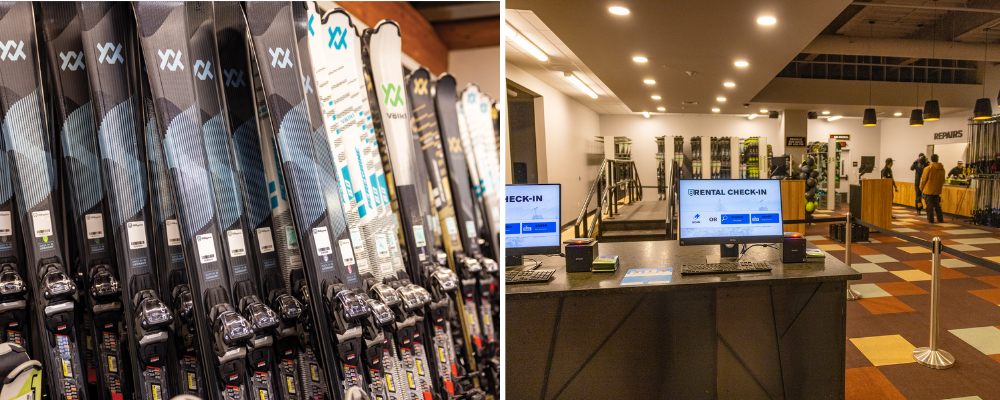 Left to right: Killington, with four rental shops spread across the resort, stores data in its RTP enterprise system; Killington captures most guest rental information at check-in stations in the shop.
Killington and Pico
Killington and Pico, Vt., manage a combined fleet of approximately 2,000 skis and 600 snowboards across four spread-out locations. RTP enterprise software has been used across the resort for four years, including for rental and retail operations. Rental manager for the past five years, in the department for 11 years in all, is Oliver Hardy. He’s still looking for the best ways to manage the sprawling business.
Killington evaluated Easyrent, says Hardy, but the resort prioritized the ability for guests to be able to do one-stop shopping for rentals, tickets, and lessons through the RTP enterprise system. So, the resort uses the RTP rental module, a less complete solution for managing rental department data.
(Ed. note: According to Trever Hinckley, rep for Easyrent at Wintersteiger, RTP and Easyrent are in the process of integrating the two programs at the urging of RTP customer Telluride, Colo. This will provide all RTP customers the option of a robust rental-optimized software module.)
“All of our data and rental info is captured in the RTP software that we’re using to sell the ticket and lesson product,” Hardy says. “But it’s been a bit of a labored process to collect data beyond the guests’ purchasing information.”
Killington has experienced some challenges with gathering information such as the skier’s weight, height, and other metrics through the RTP software. After one season of gathering renters’ info in advance, last season techs recorded this data in the shop, Hardy says.
Liability and Indemnification
The push for data tracking and documentation is driven in part by liability issues, and in particular, the rental shop indemnification programs that ski-binding companies offer to transfer some liability concerns from resorts to the suppliers. Each indemnification program is unique, but if rental shop operators follow the requirements of these programs, the binding manufacturers provide, say, $5 million of coverage for an equipment-related lawsuit.
In exchange for offering that level of protection, manufacturers’ indemnification programs require a variety of different forms of documentation, including liability release and post-accident forms. “So much of the liability comes back to us as a manufacturer, and that’s why we have a really in-depth indemnification program,” says Head Tyrolia marketing manager Marshall Mayhew.
Follow the standard. The indemnification programs are linked to the shop and binding testing procedures standards developed by the ASTM F27 Committee on Snow Sports. The suppliers’ tech manuals and procedures are designed to ensure operators are in compliance. Marshall notes that these programs are updated periodically as the ASTM standard evolves, and resorts must adapt and change as well. For example, three years ago, ASTM ruled out the longstanding practice of using “correction factors” to adjust the DIN settings for bindings that functioned properly but whose indicator scales were either too high or low.
Liability can be expensive. These programs are especially important this year. “Right now in the insurance market, especially for general liabilities, we’re in a really hard [read: expensive] market, worse than the market was in ’88,” says Tim Bruce of Safehold Special Risk. That’s saying something, as anyone who endured the late ’80s insurance market knows.
Another reason for diligence: costly lawsuits. “Some of the awards coming out of the court systems are just nuclear,” Bruce warns. “And we don’t see that changing.” He cites a catastrophic injury case that set a life care plan of $50 million.
Handle with care. As a result, Bruce says, a catastrophic incident involving rental gear will lead an insurer to pull together all relevant records and data immediately—and perhaps pull the gear involved as evidence. He recommends that resorts establish a “cat loss protocol” that describes how to handle such incidents, including taking the gear out of service and preserving it in “as-is” condition.
Careful handling is imperative: “If we do have a problem with a claim and you’ve destroyed evidence,” Bruce says, the next question is, “what else have you destroyed?”
One step Bruce recommends to preserve documentation is for operators to keep two copies of the suppliers’ tech and indemnification documents: one for regular use, and a second clean copy for safekeeping and possible use as evidence in a lawsuit.
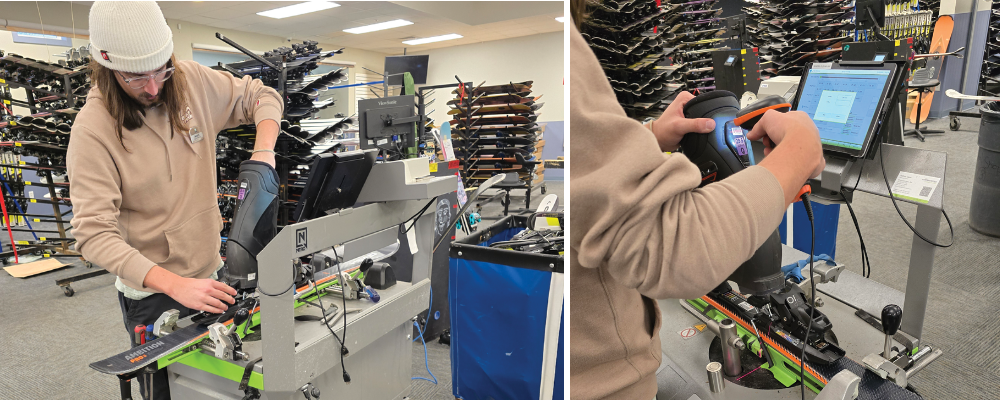 Left to right: A tech at Massanutten runs a binding check with the shop’s automated Safetronic test machine; Massanutten instituted a barcode system through its Easyrent software so that techs can scan and quickly access renters’ setting info.
Binding Testing
Binding testing is a key part of indemnification programs. The shop procedures standards describes how rental operators should test bindings (for skis, not snowboards) pre-season and then select and test gear in-season to ensure boot-binding systems are functioning as intended. A key requirement is to test 5 percent of a fleet every two weeks during the season, a process that helps detect any fleetwide issues that might trigger a need to test a greater percentage or even all of a fleet.
Keeping track of all the data generated, in an easily searchable system, requires diligence.
The choice of test equipment can help. There are basically two choices: the manually operated Vermont Release Calibrator and automated machines from Wintersteiger or Montana. The automated machines can record the test results and export them to a database or software system, but the machines are more costly than the Calibrator—roughly, $20,000 to $30,000 vs. $6,500. That often leads ski areas to the Calibrator, which requires manually recording the results.
Powder Mountain’s transition from the Calibrator and manual data recording to digital recording with the Safetronic has been beneficial, Egli says. “In tandem with my maintenance log, we also generate a CSV file that I can lean on to show exactly the numerical values of how each binding tested and the exact timestamp and date on when it was done,” he says.
At Massanutten, the rental department’s Easyrent software automates several tasks. Pre-season, it tracks which gear has been tested or not, and prevents untested gear from going out with customers. In-season, it automatically selects gear to test and records the data from the Safetronic, including the test values, date, time, and ID of the technician.
The process is similar at Killington—up to a point. The resort uses a Safetronic binding tester at its main shop, and relies on the Vermont Calibrator at the satellite shops. The data from both systems get manually recorded in RTP, though it takes a bit more effort on the part of the techs at the remote shops. The techs write down on paper the ski number and the person who did the testing, along with the test result and date of the test. “Ideally, I’d like to get another Safetronic to make life a little easier at those satellite shops,” Hardy says.
Training and Certification
In the past 25 years, training and certification have shifted from all hands-on training toward including the more uniform and easier to document online training. The online portals provide 24/7 access to training materials, manuals, and certification records.
This information benefits both rental operators and the binding suppliers. “There’s a lot of steps that you have to take before you can even start certifying your technicians,” Head Tyrolia’s Mayhew notes. “We want to make sure that we have all the archives of technicians that are certified. Keeping that information on hand is extremely important.”
Still, making binding adjustments and understanding how to read adjustment charts requires hands-on practice, so shops typically include this as part of the total training package.
At Powder Mountain, in addition to getting staff indemnified with Look, Atomic, Salomon and Marker via online training, “we’ll spend three, four days preseason training the staff on proper setup of gear, and how to use the rental system effectively,” Egli says. “That training then continues on a bi-weekly basis throughout the season.”
The continuing training includes refreshers and test scenarios to make sure staff can handle all customer needs, requests, and questions. Egli also prints out online handbooks and puts them into binders for staff to reference in the shop as needed.
Massanutten follows a two- to three-week preseason hiring and online training process. The technical portion is similar to Powder Mountain’s. However, due to its particular staff and clientele—80-90 percent of the guests are beginners, and many of the staff are J-1s who may not be familiar with skiing and riding—Massanutten has added several guest service modules to improve its communications about the inherent risks in winter sports. All the online training is run through the HR department.
A hands-on emphasis. Killington also uses the manufacturers’ online resources but conducts more face-to-face training, with shadowing to ensure technicians master binding setups and inspection language. “It’s 90 percent hands-on, face-to-face training,” Hardy says. “We’ll bring everybody in for what we call an orientation just to get people familiar with the flow of our shop. Then we sit everyone in a room and go through figuring out DINs, figuring out binding settings, inspections, that type of thing.
“They then have two to three shifts shadowing somebody, or with someone shadowing them while they’re teching skis and setting bindings up, just to make sure that their phrases, wording, all of that’s correct,” he adds.
Hardy plans to add online quizzes this year to reinforce knowledge. He says the RTP scheduling/payroll software can be used to “send out a quiz of 10 questions,” such has how to determine the DIN setting for a given set of guest parameters. While the RTP rental software typically computes the binding settings, he notes, “you have those days where the power goes out or the internet’s down” and staff have to determine the settings themselves.
And whether the computations are done by the software or the human beings, it all must be documented. According to Safehold’s Bruce, ski areas should retain this documentation for at least seven years. He also suggests that any “inherent risk” communication be scripted, so that it is delivered consistently—and documented.
Mountains of Data
Modern resorts run on data across all departments, of course; rental departments are not different in that respect. However, there are several points of potential liability in rental operations, and these make accurate and complete record-keeping especially valuable.
As resorts set budgets and make decisions regarding software, it’s important to be aware of the specific needs of rental operations and how to integrate those needs into the overall enterprise. Just as resorts tweak rental systems to streamline steps and speed guests through the process, they need data systems that streamline tasks and speed staff through their responsibilities. The cost of doing less could be great.