




Panther Mixer
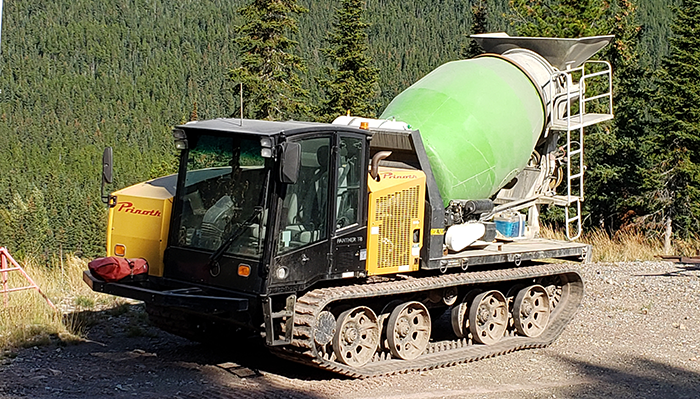
Castle Mountain, Alberta, installed a high-speed quad chairlift this past summer to serve what was previously a cat-skiing zone. It was the biggest project in the area’s history. Moving concrete up the mountain to pour tower footings presented challenges, among them narrow work roads that concrete-truck drivers were hesitant to drive. Project manager Katherine Seleski needed a solution. Castle had rented several Prinoth Panther T8 tracked vehicles for the project, so Seleski, having seen a tracked vehicle with a concrete mixer on the back before, sought out a right-sized, skid-mounted mixer to retrofit to the flatbed of one of the Panthers. She found “the last one in North America (I swear, I called everyone),” from Ready Mixer in West Virginia. With the rental company’s blessing, the Castle team welded attachments to a Panther T8’s deck and mounted the mixer, which allowed them to deliver concrete via the tight roads. The solution, while not perfect or fast, said Seleski, saved Castle $300,000 to $450,000 in helicopter transport costs and allowed them to pour in any weather.
Hands-Free Water Stations
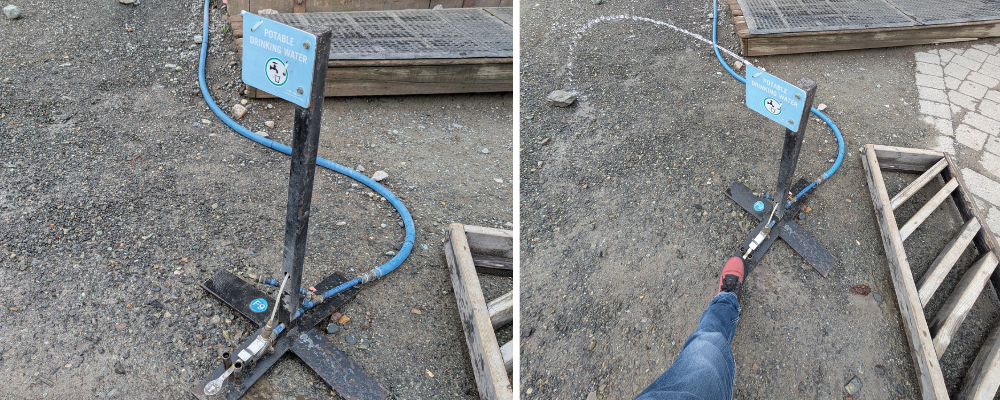
British Columbia’s Whistler Bike Park attracts hundreds of thousands of riders every summer, and they need to stay hydrated while on the mountain. During the pandemic, the hand-operated water fountains that the Whistler Blackcomb snowmaking team had previously installed (which cleverly used mountain bike handlebars mounted on a stem, attached to a fence, with a fountain head on one end and a tap to fill water bottles on the other) weren’t safe, as a hands-free solution was needed. So, the snowmaking team created a freestanding foot-pedal-operated water fountain. It was so successful that more were built and they’re still in use today around the bike park. Mounted to a freestanding lift-load sign mount, the hoses, connections, and pedals are all basic, store-bought hardware. The fountains are put together using different FIP and pex fittings, ball valves, and thread adapters. Subsequent improvements have included changing from a plastic hose (which degrades in sunlight) to a 6-foot braided supply connected to the garden hose that supplies the water.
Downspout Boot Dryer
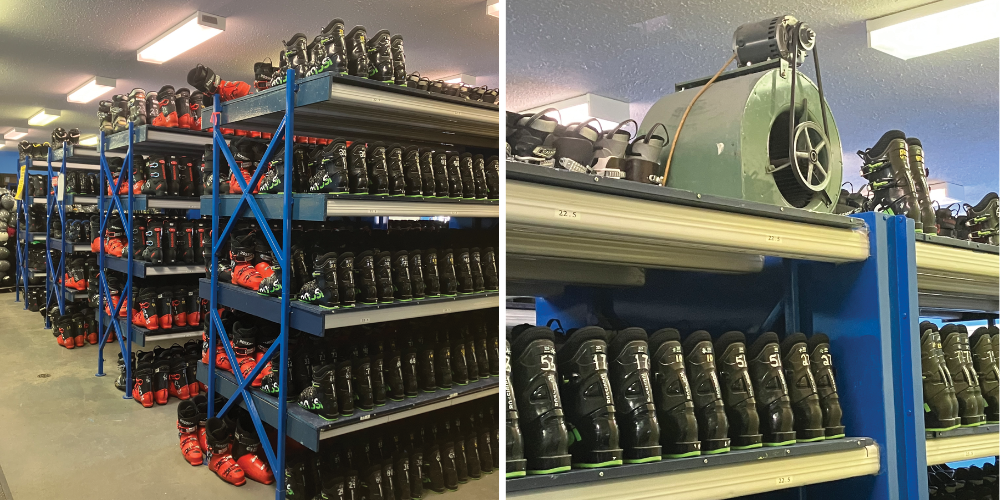
As is the case with many Saskatchewan Prairie ski area operators, longtime Table Mountain general manager Lawrence Blouin and his staff are creative problem-solvers. Among their many clever, DIY solutions is this rental-boot dryer. “We needed a large boot dryer system to dry our rental boots overnight, so we put our feverish little brains together and came up with this plan,” said Blouin. Using aluminum downspouts—typically used for roof gutter systems—as the air distribution pipe, they got a local shop to build the center duct so the ends of the down spouts would fit into it. Blouin’s team built the rest of the infrastructure and assembled it in their shop, using an old furnace fan to pump air through the system. Holes punctured in the down-facing side of the horizontal downspouts are spaced directly above boots lined up on the shelf below. Blouin said it works great, and can dry more than 900 pairs of boots at once.