



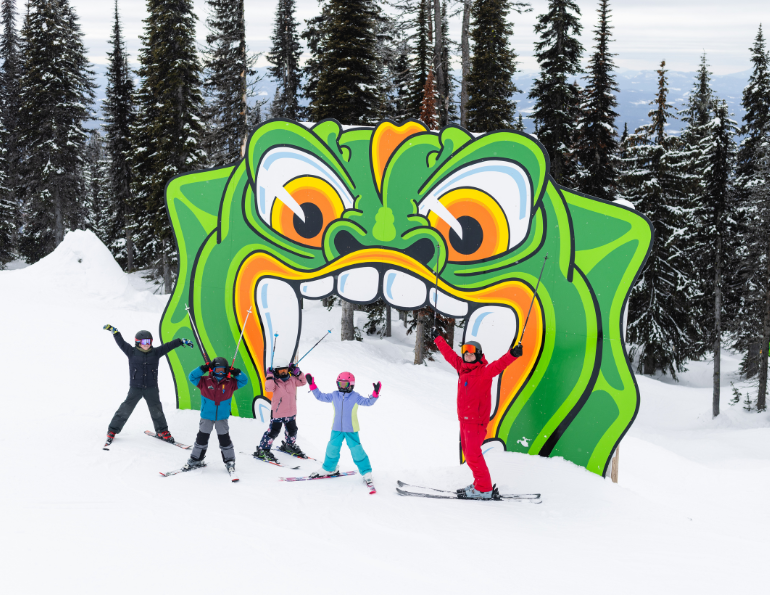
Ski areas large and small are newly and keenly focused on family-friendly fun, particularly hiking and skiing trails that appeal to the young and the young at heart. With somewhat minimal financial investment, these trails are becoming attractions and, resort operators believe, are driving up both customer satisfaction and guest numbers overall.
Of course, there is more to it than slapping a fun name on a gentle tree trail or hiking path; successful family adventure trails both fit into the landscape and flow of a mountain and embrace and reflect its culture. A great location and thoughtful, creative theming are key elements as well.
Big White: Ogopogo Trail
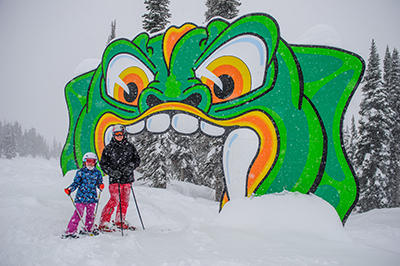 Learners enter Big White’s (B.C.) Ogopogo Trail by skiing through the mythical sea monster’s gaping mouth, the first of several themed elements. Credit: Big White Ski ResortBig White’s focus on family is intentional: “The magic of Big White is that we put our kids’ center in the middle of the village,” says resort senior vice president Michael Ballingall. “That’s expensive real estate, but we put it there for a reason. It’s an example of our focus: make it easy for moms and dads, and all the rest will fall into place.”
Honoring local lore. That comes to life on snow through the resort’s Ogopogo Trail, a themed, gentle glade trail about 0.84 miles long (1.35 km) that debuted in 2014 and was revitalized for the 2025-26 winter season. It both helps young skiers elevate their skills and celebrates an ancient First Nations tale, popular in the region.
According to legend, Ogopogo is a mythical sea creature akin to the Loch Ness Monster that First Nations people believe inhabits nearby Okanagan Lake, a huge British Columbia fjord lake 84 miles long and 3 miles wide.
The trail begins at Ogopogo’s head, a ski-through archway of its gaping mouth, and as skiers work through the ungroomed but mellow glades, they come across the rest of the body, piece by piece, with more archways that look like the sea creature’s green and orange body, before wrapping up the run by soaring past the end of the monster’s giant tail.
“The kids see it and use it in lessons, and it’s the first place they want to take the rest of the family to. It’s become incredibly popular,” Ballingall says.
Last year, Big White worked with a signage company to create the updated monster effects, including bigger archways to make it easier for parents to join the fun. The new features cost about CA$75,000 and the whole project took about six months including installation. The features stay up year-round.
Know your audience. In developing kid-friendly activities and features like the Ogopogo Trail, Ballingall says Big White enlists the resort staff’s own kids for product testing and feedback. “We just build things our kids would find fun. We test it on them. If our kids love it, other kids will too.”
Other ideas for how Big White can better serve families are gathered organically by simply talking to locals. “We attend community events, barbecues, etcetera, and we literally just talk to moms and dads about what their kids love,” says Ballinghall.
The resort is currently investing more than CA$1.5 million in other family-friendly upgrades such as beginner area improvements including a domed conveyor lift, all with the same confidence the team has in the Ogopogo Trail.
“Every time we make a decision focused on family,” says Ballingall, “it pays off.”
Sun Valley: Sunny’s Adventure Park
With locally created artwork and interactive features, Sun Valley’s new Sunny’s Adventure Park quickly became a popular area on historic Dollar Mountain during its debut in 2025-26.
European inspiration. Development of the 2.5-acre zone was led by Sun Valley ski and ride school director Stephen Helfenbein in collaboration with terrain park consulting company Effective Edge. The aim was to create an interactive and exciting new learning space similar to “fun slope” setups in Europe that combine various man-made elements and themes to add some entertainment to the beginner experience in areas above tree line.
“Most ski area ‘learning trails’ are tree trails,” Helfenbein explains, because skiing around trees and choosing varied paths helps the learning process. “There are no tree trails on Dollar Mountain, so we needed this.”
Instead of trees, Sunny’s Adventure Park has a variety of fun and creative installations that also serve a purpose. For instance, there’s a punching bag that skiers and riders must navigate their way to, in control, and come to a balanced stop in front of to attempt the activity (and who wouldn’t want to ski up to a mid-mountain punching bag and take a swing?).
A learning tool. “It’s just another example of letting the terrain do the teaching,” says Helfenbein. “You just kind of make turns off your vision. You see something cool and want to go there. Then you have to stabilize yourself to punch. It works.”
The adventure trail is also conspicuous to its target audience, intentionally located near the primary learning terrain. “It draws you in,” he says. “You cannot avoid seeing it.”
The bright blue and orange designs that adorn the various elements in Sunny’s Adventure Park were created by local artist Kika MacFarlane, who’s other work for the resort includes designing the logo for Sun Valley’s Baldy Bluebird Music Festival.
Effective Edge president and CEO Mike Bettera worked with Sun Valley throughout the planning and design of the project, including on the design of the physical features that include arches, slalom gates, banked turns, rollers, the punching bag, a bear with a swinging paw for high fives, and a large snow tunnel that’s built using an inflatable mold.
Helfenbein says it cost roughly $30,000 for the physical elements such as the tunnel mold and the foam and wood objects (animals, arches, etc.). Even with consulting and building costs added in, it adds up to a relatively small investment for what has been a strong return so far.
“It was used every day and all day,” says Helfenbein. “It’s very popular. People say it’s their favorite thing here.”
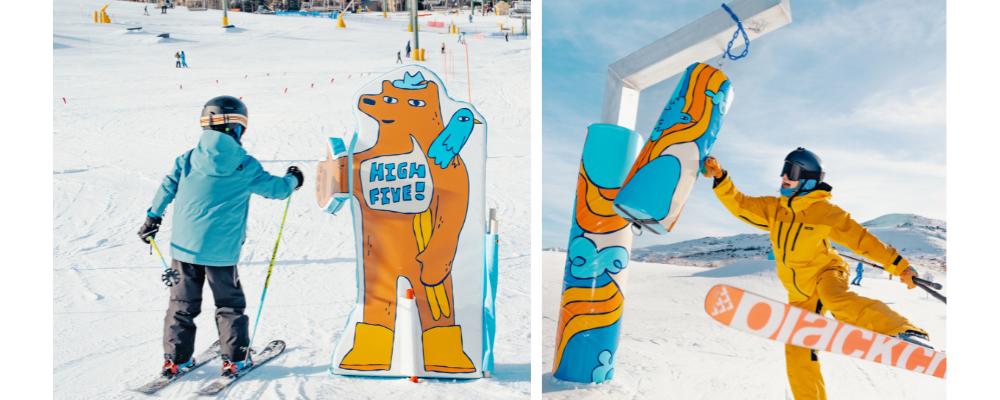 The new Sunny’s Adventure Park at Sun Valley, Idaho, is filled with fun elements designed to make learning more engaging.
Whistler Blackcomb: Kids Adventure Trail
British Columbia’s Whistler Blackcomb has long been known as a hiker’s nirvana. There are trails of all length and difficulty with enough variety to attract return visitors for years.
But until recently, the resort was short on one vital ingredient: true family-friendly hiking trails, particularly up on the mountain. “We wanted to provide more experiences for kids up there,” says Wendy Robinson, senior manager of resort planning and business development.
So the resort developed its Kids Adventure Trail, a distinctive and easy-walking pathway with fun and interactive signage and breathtaking views.
In-house job. The project—while it required moving heavy stones—was a relatively easy lift overall, Robinson says, and it was all done in-house, which reduced the cost significantly relative to hiring an outside company.
“The trail itself was roughed in by machine, and it didn’t take too long with the trail being at tree line, in a krummholz-type zone,” she says. The rocky terrain was a help rather than a hindrance. “We used the rocks in that area, all native to that space. We did the initial build and then came back to fill the gaps with dirt and clean up the trail for hiking.” Some of the rocks were arranged to act as steppingstones along the trail.
Then the final details came. “We worked with the Whistler Naturalists to pull together the local flora and fauna content for the interpretive signage, and a local artist to design the creative. Once that was dialed in, it didn’t take much to install the signage and open the trail,” she says.
Engaging for all. The interpretive signage highlights “animals you can actually see from the trail or the gondola,” says Robinson. For instance, at one rocky viewpoint there are signs about birds in the area, as well as signs in the clearing highlighting other animals one might see. The goal is to have hikers read the signs and then be able to identify the animals and birds they spot, making the trail educational and engaging (the latter especially important with kids).
Another key element is its accessibility. The green-rated trail is close to the Blackcomb Alpine Loop so it’s easy to access from the Blackcomb or Peak 2 Peak gondolas.
A play structure was added in the same area, too, made from repurposed old chairlift decks and wooden utility poles for kids to romp around on while the adults take in the scenery. Its modular structure allows it to be broken down and stored for winter.
The net result? “We see families spending more time up on the mountain,” says Robinson. “We are getting families out there together to explore. Local families love it, too.”
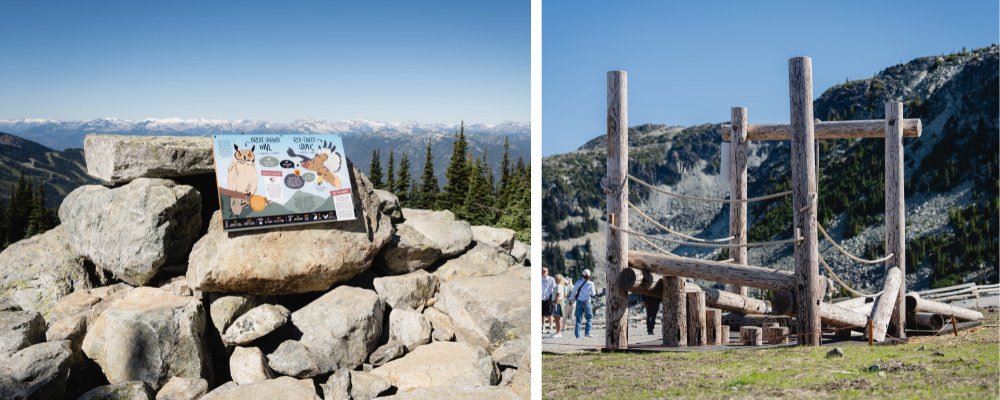 Interpretive signage along the Kids Adventure Trail (left) and a nearby play structure (right) keep kids engaged at Whistler Blackcomb, B.C.
Grand Targhee: Nel’s Discovery Loop
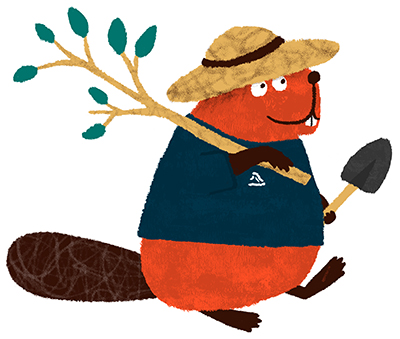 Nel the Beaver leads the theming for the new Nel’s Discovery Loop at Grand Targhee, Wyo., which debuts this summer as a no-cost activity that aims to encourage guests to spend more time at the resort.Grand Targhee had long been considering how to make its summer experience more family friendly. Inspiration came when resort personnel experienced Whistler Blackcomb’s Kids Adventure Trail at the 2025 SAM Summer Ops Camp and went back home with some ideas in mind.
That’s how Nel’s Discovery Loop, Targhee’s new family-friendly trail that debuts this summer, came to be.
Indirect ROI. “There had been a lot of hesitation to move forward with things without a direct monetary tie,” says director of marketing and guest experience Jill Gaylord, “but once we saw with our own eyes people enjoying these [types of trails], you see ancillary spending increases.”
Nel, the lead character of the trail, is a beaver (since beavers are trail builders). The half-mile loop, with a stroller-friendly smooth surface and mellow grade, has been set just off the base area for easy access and allows foot traffic only.
The trail is dotted with fun informational signs. Gaylord used a keen-eyed expert to help develop those: her six-year-old son. Hikers are prompted to look for things like animal tracks, birds, and certain trees.
Gaylord says trails like this amp up “hang around time,” which adds up to more spending by guests and a better overall experience.
An accompanying activity book will help guide guests along the loop while also providing a take-home item to remind guests of their experience.
The project also inspired other family-friendly additions, including a new playground close to the resort’s restaurant area. “We want more activities with a low barrier of entry, as opposed to mountain biking,” Gaylord says, adding that Targhee is getting rid of its trampoline and climbing wall because “everyone has those. We want to be different.”
Blue Mountain: Woodview Mountaintop Skating and Hiking Loop
A mountaintop winter skating loop that converts to a doable summer hiking path? That’s a dream that Blue Mountain, Ontario, has realized.
Location is everything. The resort’s Woodview Mountaintop Skating Loop debuted in 2018 and has quickly become a popular outing. The 1.1 km loop is carved through a forest along the Niagara Escarpment, Canada’s famed 1,000-mile ridge of limestone that is home to Niagara Falls.
The loop is mostly flat, maxing out at a 1 percent grade, which makes it possible to use for skating in the winter and easy hiking come summer and fall. It’s easily accessible to parking and the top of a lift. At night, elegant lighting complements the natural surroundings.
In other words, the resort nailed the location.
That, says president and COO Dan Skelton, is key to any kind of family trail success. “The location must be compelling,” he says, pointing out a flatter path, great views and/or a scenic forest as excellent characteristics for a trail. “And it should complement the ski resort, not compete with it,” he adds.
Access. The loop converts easily from skating to hiking come spring. Access to the loop also converts: During the winter, guests drive themselves up to the summit and park their cars at the Woodview Activity Center to skate. During the warm months, they take the Silver Bullet lift up to hike the loop—after ski season ends, the resort replaces the lift’s six-passenger chairs with open-air cabriolet cabins until Thanksgiving.
Skelton says the skating loop has been wildly popular with both skiers and non-skiers.
“We did know that a lot of people come to the resort looking for things to do besides skiing,” he says. “We have our mountain coaster, tubing and snowshoeing, but this addition has really pleased the guests.”
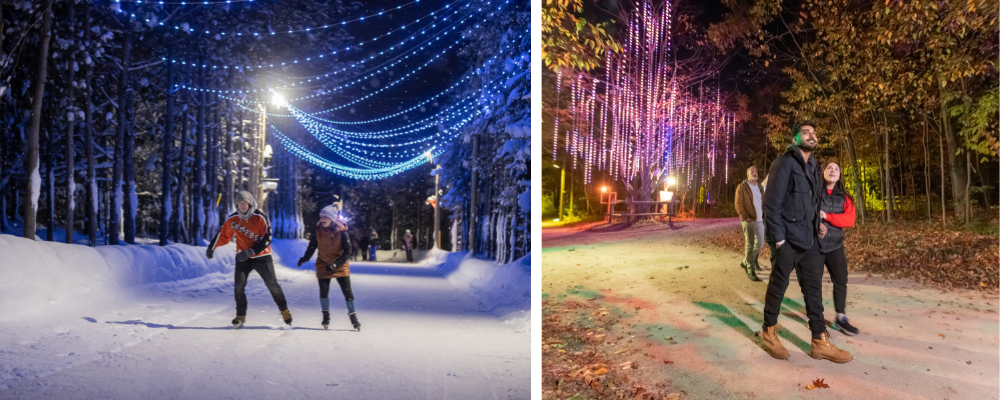 Blue Mountain’s (Ont.) Woodview Mountaintop Skating Loop (left) converts into an easy hiking trail during the non-winter months (right).
Bottom Line
Successful family adventure trails combine accessible location, mellow grade, connection with nature and/or strong theming and, typically, a relatively small upfront investment, resulting in guests staying longer, spending more, and wanting to come back. For resorts increasingly focused on four-season visitation and family participation, that is a compelling return on investment.