




It was a cold December evening in 2020 at Hyland Hills, just outside Minneapolis. The sun had just dipped below the horizon, but in true Midwestern fashion, my night of skiing under the lights was only beginning. I climbed the steps to the base area—and there it was.
Before me spun a sight I had never experienced in more than 30 years on snow: a side-by-side rope tow, shuttling skiers and riders uphill in a constant, chaotic rhythm. The ropes never slowed, but kids were packed elbow to elbow, and for the first time in my skiing life, I felt intimidated not by the terrain, but by the lift.
That moment changed the way I thought about skiing.
From Ingenuity to Industry
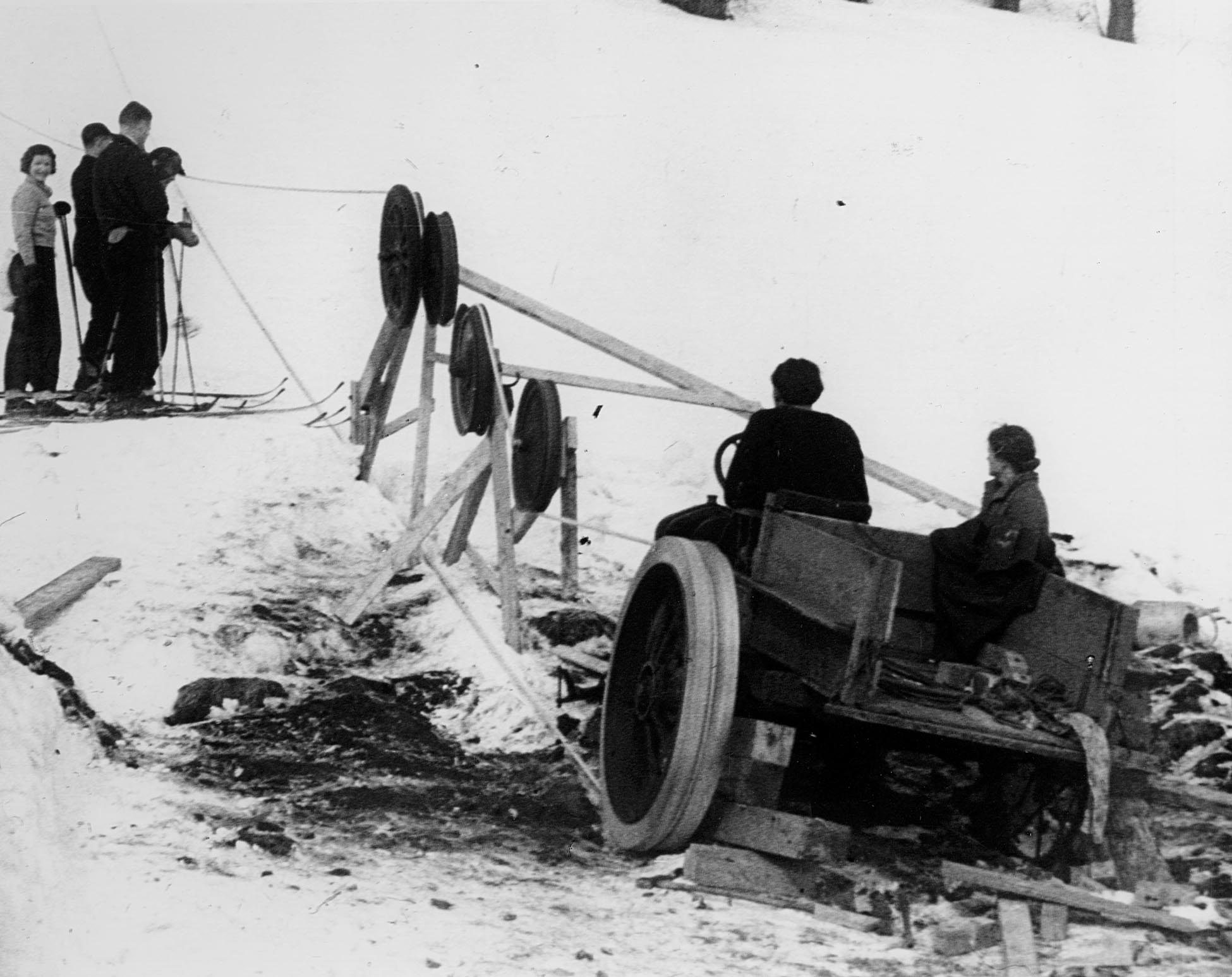 The first rope tow in the United States at Gilbert’s Hill in Woodstock, Vt., was powered by a Ford Model-T engine. Source: Woodstock Historical SocietyUphill transportation is a defining element of ski areas, brought about so skiers wouldn’t need to hoof it up to ski down. One of the earliest ideas to accomplish this was the rope tow, which got its start in North America nearly a century ago. In 1931, Alex Foster, in Shawbridge, Quebec, watched skiers tire themselves out hiking uphill. He thought there had to be a better way. So, he gathered 730 meters of rope, some telephone poles, pulley wheels, and a Dodge engine mounted to cement blocks, and the very first rope tow spun into existence.
This simple idea spread and forever altered the sport. By 1934, the first rope tow in the United States was spinning on Gilbert’s Hill in Woodstock, Vt. Built by local handyman David Dodd, it was the result of a collaboration between the Gilberts, the Royce family, and skier “Bunny” Bertram, who had been inspired by the European cable cars that transported skiers up their mountains. That early tow used a large loop of rope powered by a Ford Model-T engine. The Woodstock tow transformed skiing from a niche activity for athletes into something families could enjoy in an afternoon.
Soon, rope tows popped up across the continent. Beer magnate and Bromley (Vt.) founder Fred Pabst Jr. even formed Ski Tows, Ltd. (later Ski Tows, Inc.), which got its start installing and operating several rope tows at its ski areas throughout the Midwest, East, and Canada in the late 1930s. Rope tows were essential in launching the modern ski industry—though challenges loomed ahead.
Alternatives Emerge
While inexpensive and efficient, rope tows weren’t without challenges. Their speed and grip demands made them hard to master, leading to falls, pileups, and plenty of blooper reels in Warren Miller films.
Other innovators sought more user-friendly alternatives. The first Pomas, T-bars, and J-bars appeared in Europe in 1934. In 1936, James Curran’s chairlift marked a leap forward. Through the mid-20th century, many rope tows were replaced or relocated.
The ones that remained often served beginner areas, even though they were ill-suited for novices. When conveyor lifts debuted in the 1990s, it looked like rope tows might vanish entirely.
The Midwest Rope Culture
Instead, a second chapter began. During the mid-’90s, terrain parks were booming in the Midwest, and operators sought affordable ways to give snowboarders and skiers quick laps. At ski areas such as Hyland Hills and Wisconsin’s Trollhaugen and Tyrol Basin, the rope tow was the answer.
That was when operators realized rope tows are more than just functional—they create a culture. They give riders their own dedicated spaces, echoing the energy of a skatepark. “When you put all those park kids in their own zone on their own rope, they’re as happy as they can be, and guess what? They’re not clogging your lift lines,” says Day Franzen, longtime park builder and owner of Kingvale Resort, Calif.
Trollhaugen mountain manager Adam Mahler says that while chair-served parks are still fun, hot laps aren’t an option so it’s harder to get into a flow. “The constant movement of a rope gives you that instant gratification,” says Mahler.
So, hot laps became a thing. Snowboarders, no longer forced to unstrap their rear foot, could endlessly lap features. Thus, generations of park kids grew up pushing progression, watching each other from the rope, and hanging out at the top.
“The vibe changes within the community,” Mahler says. “You’re watching your peers land tricks in real time. Who knows—you might even be riding with your favorite pro. The hangouts at the top when you’re taking a break are what shape the culture in your parks.”
That culture reshaped skiing in the Midwest and seeded a small but growing resurgence of rope tows nationwide.
Back to the Beginning
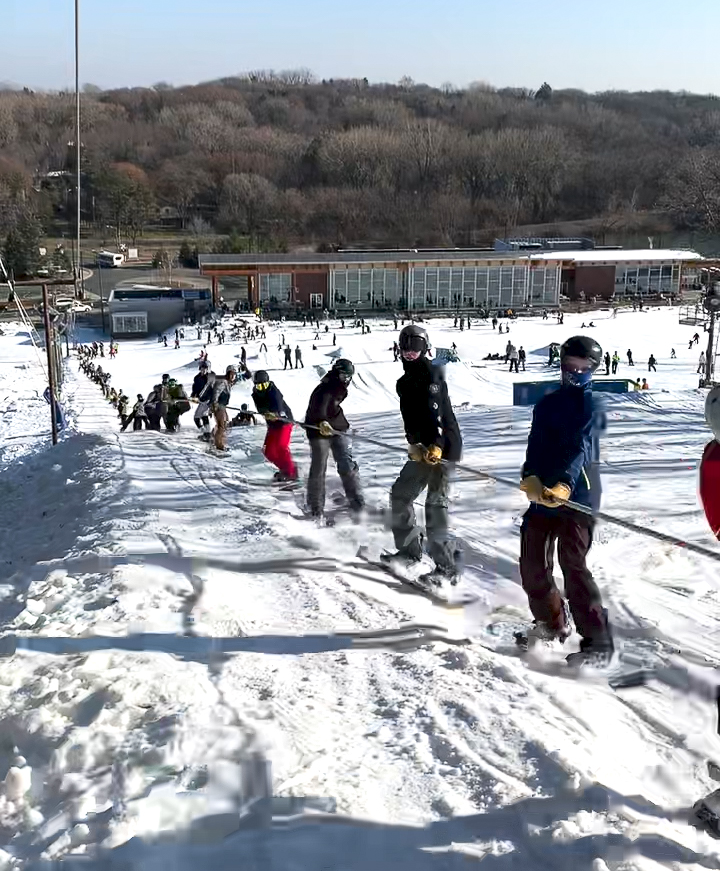 The constant flow of the rope tow allows for hot laps in the popular Hyland Hills, Minn., terrain park. As I stood at the base of Hyland on that cold December night, though, I didn’t yet understand all of that. All I could see was a rope tow hauling dozens of riders uphill each minute. The efficiency was mesmerizing—ropes spinning nonstop, no breaks in the chain of skiers and riders, all flowing in perfect rhythm.
After watching for a while, I finally mustered the courage to grab hold—and after that first ride, I was hooked. For the first time, I actually got a workout lapping a slope with only 200 feet of vertical rise. I could see that the efficiency, speed, and sheer practicality made this lift perfect for Midwestern hills. And I wasn’t alone in that realization.
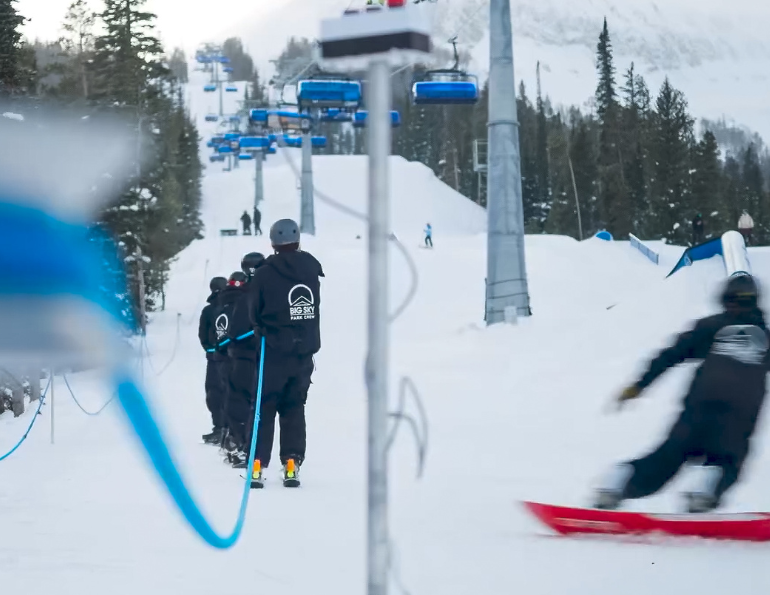
In just the past few years, the Midwest has added more than half a dozen new ropes. The movement has spread, too—from Snow Trails in Ohio to Big Sky in Montana.
At Snow Trails, GM Scott Crislip says the reduction of traffic on the chairlift that used to serve the park was immediate. “The park riders absolutely love the rope tow, and the general skiing public definitely noticed less congestion.” The resort is adding a second rope this year to serve its beginner park. His advice to other operators? “If any area has been on the fence … I’d say go for it.”
Why the resurgence now? The answer isn’t just about culture—it’s also about math. Rope tows make sense on the balance sheet as much as they do on the hill.
Efficient, Effective, and Economical
Beyond culture, rope tows make business sense. A single rope at Hyland Hills can move roughly 5,000 guests per hour—more than twice the capacity of a fixed-grip quad. (Ed. note: This capacity estimate is based on the author’s timed field observations and calculations; not a manufacturer rating.) “It almost always comes back to speed… or cost,” explains Will Mayo, owner of TowPro Lifts. “And this is the most affordable lift that you can get.”
The financial equation is compelling. Where a chairlift can run millions to install, a rope tow is a fraction of the cost. For smaller hills, that affordability can be the difference between survival and closure. “The whole point [of TowPro] is to make it possible for the little guy to keep serving their local community,” says Mayo, who even hopes to see “more municipal hills built out with turnkey rope tow kits.”
For resorts, the payoff is clear. “It keeps lift lines down, brings in more customers, and the maintenance costs are significantly less than a chairlift,” says Mahler.
Rope tows can also reduce staffing demands. In many states, a single employee can oversee a rope tow with clear sightlines, allowing operators to run these lifts with less than half the staff typically required for aerial lifts. Ski areas such as Kingvale often assign their park crew to operate the tow, integrating lift duties into their regular responsibilities.
Franzen notes that this approach also gives staff a sense of ownership over the park experience. “Your park staff rotates in and out of the lift all day. It gives them something to do, and they take ownership of it—it’s their baby.”
Costs and throughput aside, rope tows also carry a safety advantage.
Spinning Toward Safety
Rope tow safety is simple when it comes down to it. With no passengers suspended in the air, rope tow mishaps are rarely serious, say insurers. Save for the occasional pileup, riders simply let go when trouble arises.
“As soon as you pick people up in the air, you need a lot of additional systems to ensure it’s safe,” suggests Mayo. A rope evacuation will never be needed on a rope tow.
Also, ropes help keep terrain park riders in the park, and that provides safety advantages as well. It minimizes situations where guests are speeding down runs just to get to a park, potentially causing a collision.
“We have a huge infrastructure at Big Sky, but we also have a rope tow,” says Jeremy Cooper, VP of mountain sports development for Boyne Resorts, which owns Big Sky Resort. “The driving force behind that was not only guest demand, but also the reality that mingling beginners with park riders didn’t lead to the best guest experience. Isolating user and skill groups helps prevent that.”
Taking together culture, cost, efficiency, and safety, rope tows are more than a relic. They’re carving out an important role in the ski industry for both mom-and-pops and larger resorts.